
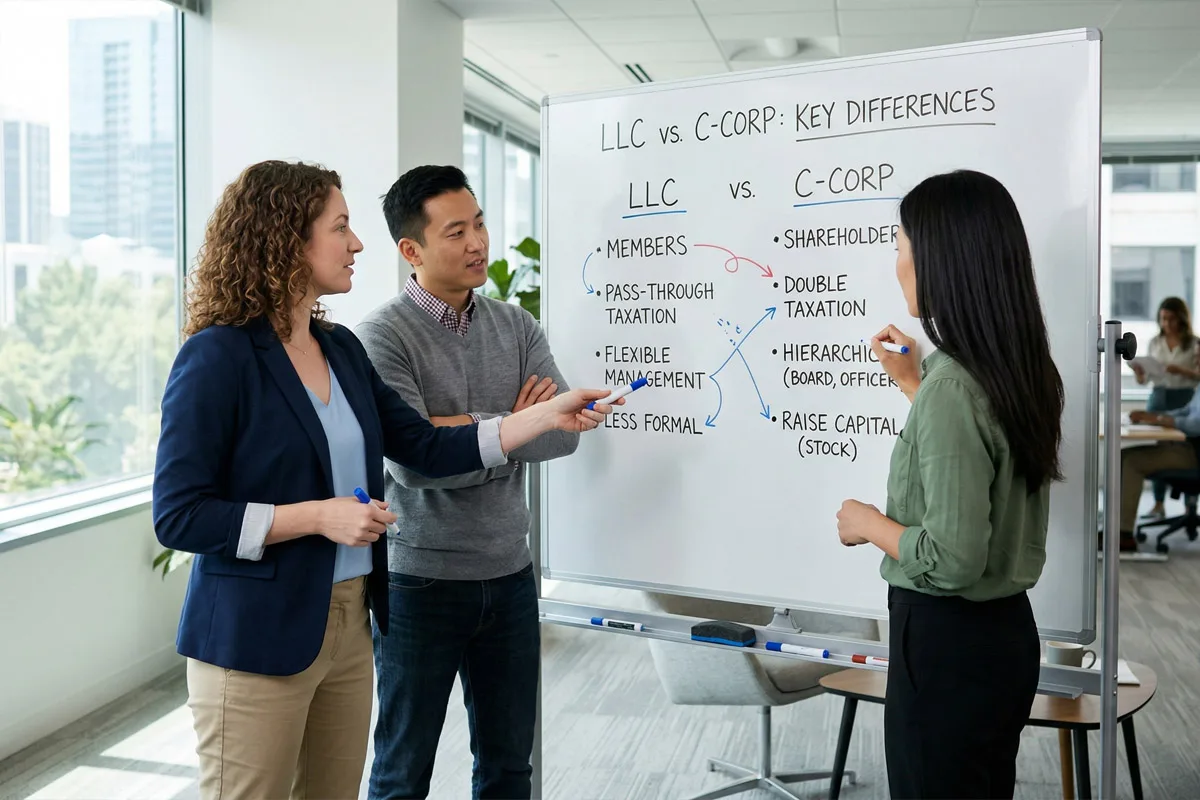
Where to Start
You should start not with the name of the entity type, but with your business model. The same project can work well as an LLC and poorly as a C-Corp — or vice versa — depending on profit, losses, dividends, and growth plans.
The Basic Logic of Choosing
In practice, the choice almost always comes down to three things:
- who the company owners are and where they live
- how the tax regime will work in the early years
- whether you need growth through investors, equity sales, and a more complex corporate structure
Why Tax Logic Matters More Than the Name
Essentially, you are choosing between two approaches. In one case, the company exists as a separate tax entity. In the other, profits and losses pass through to the owners. That's where the difference in taxes, reporting, and structural convenience comes from.
If you want to quickly pull out profit, that's one scenario. If the business will grow through reinvestment and may be unprofitable in the early years, that's a different scenario entirely.
When People Typically Look at LLC
LLC is often chosen as a working structure for startups, when a complex corporate setup isn't needed and there's no immediate goal of building a company for investment. But you shouldn't assume that LLC is automatically the simplest option.
An LLC may look simpler on the surface, but for non-residents, that simplicity often hides more complex reporting requirements.
What Non-Residents Need to Understand About LLC
For non-residents, LLC is often more complicated than what's advertised online. Additional forms, an ITIN, and heavier reporting may emerge.
If an LLC has multiple owners, the complexity typically increases even further. That's why a multi-member LLC rarely turns out to be a simple, trouble-free solution.
How This Difference Plays Out in Practice
The difference between entity types becomes especially apparent in the reporting. A foreign-owned single-member LLC often requires not only Form 5472, but also a pro forma Form 1120. If the owner is required to file a personal US tax return, Form 1040-NR and an ITIN may also be needed.
If the LLC is treated as a partnership, the entity typically files Form 1065 and issues Schedule K-1 to the partners. From there, each foreign partner may have their own US personal filing obligations, including a 1040-NR and ITIN if needed for filing.
A C-Corp often appears simpler precisely because the core tax reporting is concentrated at the entity level through Form 1120. This doesn't mean a corporation is always cheaper or simpler in every case, but for non-residents it frequently removes some of the personal reporting burden that arises for LLC or partnership owners.
When C-Corp Makes More Sense
A C-Corp is typically stronger when growth, investors, equity sales, and a clear corporate structure are important. It's a structure that's easier to embed into a larger business framework.
For non-residents, C-Corp often looks cleaner both structurally and in terms of reporting. That's why in these cases it frequently turns out to be more practical than an LLC.
Where C-Corp Has a Weakness
The weak point of C-Corp is double taxation. First the company pays tax, then a second tax can arise when dividends are distributed to the owner.
That's why a C-Corp isn't always the best option if you want to quickly extract profits. But if the money stays inside the business and goes toward growth, this downside matters less.
What You Need to Know About S-Corp
S-Corp shouldn't be seen as a universal option. It has restrictions on the ownership structure, and for US non-residents it typically doesn't serve as the default solution.
Questions to Answer Before Registering
- will the company be profitable from the start, or are losses expected early on
- do you plan to pay dividends in the first years
- do you intend to reinvest profits back into the business
- who are the company owners: US residents or non-residents
- do you need a structure that makes it easier to sell equity and attract investment
Can You Change the Structure Later
Yes, the structure can be changed later. But that's no reason to choose blindly. A mistake at the start almost always means extra costs, time, and additional reporting obligations, which is why the entity type is best locked in during US company formation.
Don't Confuse Entity Type with State Selection
Another common mistake is choosing Delaware or Wyoming first, and only then thinking about the entity type. The right approach is the opposite: first the company type and tax logic, then the state of registration.
Conclusion
To put it simply: LLC isn't always simpler, C-Corp isn't always more expensive, and S-Corp doesn't work for everyone. For non-residents and remote businesses, C-Corp is often more logical than LLC — but there's no universal solution. You start by looking at the owners, profitability, dividends, and growth plans, and only then choose the entity type.
Need Help Choosing the Right Structure?
If you're choosing between LLC, C-Corp, and S-Corp, it's better to work through this based on your specific income model, ownership structure, and growth plans — not generic advice.