
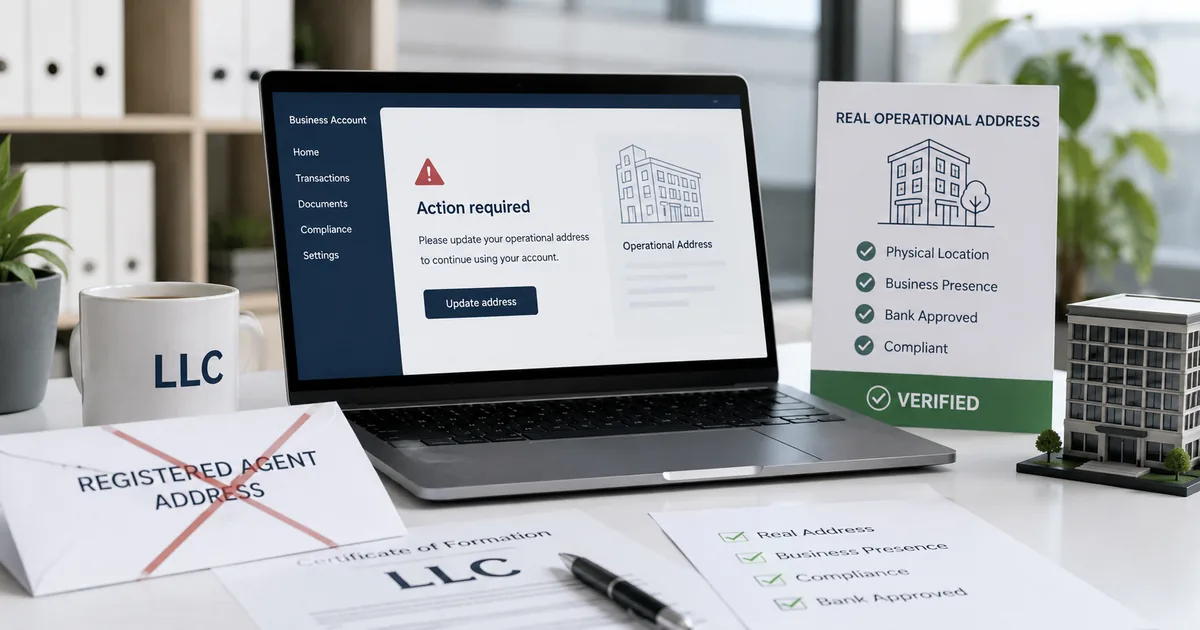
Here's what happened: in 2026, banks and payment platforms for LLCs stopped accepting addresses from registered agents. Mercury, Wise, Stripe — the main fintech rails for non-resident founders. This article covers what specifically changed, and how to set up an LLC address that clears bank KYC in a week, without waiting for the discontinuation letter.
What Mercury looks for from a non-resident LLC in 2026 — the short version:
- a real US operational address — not a registered agent, not a PO box;
- a confirmed EIN before you apply to the bank (applying before the EIN is confirmed is a common rejection trigger);
- declared activity that matches the transactions on the account;
- a minimal document trail — contracts, invoices, bookkeeping, the right tax forms;
- a basic digital footprint — a corporate domain and email on it.
The rest of this article unpacks each point and the order to do them in.
What Banks Actually Changed in 2026
In 2024, forming an LLC from abroad was straightforward. Register through an agent, put the agent's Delaware or Wyoming address on the formation documents, get an EIN, open an account at Mercury — and you were live. That playbook held for almost ten years. By the end of 2025 it stopped working.
As of May 2026:
Mercury removed registered-agent addresses from accepted data. Both for new applications and for existing customers. Existing accounts get the letter: "update your operational address or we discontinue service." It's not a filter applied only to new applicants — it's the policy applied across the base.
Wise (formerly TransferWise) now requires a physical US address. On top of that, Wise no longer opens the local USD account in the format Stripe needs — a separate problem for anyone who built infrastructure around the Wise + Stripe stack.
Stripe asks for documents tying the company to a location: utility bills, lease agreements, corporate email. Not for everyone, not immediately. But for a growing share of accounts — yes.
Each change in isolation is a one-off policy from a specific service. Together, it's already a sector shift.
Where This Came From
Not from bad will. From an ordinary chain.
Regulators noticed that the volume of "paper" LLCs held by non-residents has multiplied over the last five years. AI tools, remote work, cheaper formation — they enabled a massive international micro-industry. Inside that flow, the share of shell schemes also grew, and regulators pushed banks harder on KYC.
The same processes are running everywhere. In Europe, substance requirements have been in force for years for entities in Cyprus, Malta, Estonia. In the UK — after the Companies House reform. In classic offshore jurisdictions — BVI, Cayman — substance has become a precondition for tax residency.
The US is just catching up to the global trend, in a more explicit and faster form, because the volume of non-resident-held LLCs is enormous.
This is not "the door closing for non-residents." The door isn't closing. The frame around the door is changing.
What to Do If Your LLC Already Exists
If the LLC is registered and banking data still shows the registered-agent address, here's the algorithm. I run this setup with clients three to five times a week, so I can describe it precisely.
Step 1. Audit the current address across all banks and services. Log into Mercury, Wise, Stripe, Relay — check what's in the Operational Address or Business Address field. If it's the agent's address, the company is in the risk zone.
Step 2. Get a valid operations address. This is a virtual address service with mail forwarding, tied to a real physical location. Not an agent's. Not a PO box. I've got a few providers with proven track records: Earth Class Mail, iPostal1, Anytime Mailbox. Cost: $20–80 per month. The nuance: not every address is equally "accepted" by banks. Mercury, for example, doesn't love providers whose facilities have historically been used by clusters of LLC fronts. Before signing up, it's worth verifying the provider is clean.
Step 3. Update every bank and service. Mercury — through the support chat with a copy of the provider contract. Wise — through the business profile settings. Stripe — through business settings and, if needed, by uploading supplementary documents.
Step 4. Check that transactions match the declared activity. This is the step people skip, and it triggers compliance holds more often than the address itself. If the LLC is registered as a consulting business but the inflows are marketplace product sales, that's a contradiction a compliance officer will eventually flag.
Step 5. Assemble a minimal document pack. Contracts with key counterparties. Issued invoices. Bookkeeping. Tax forms — 5472, 1120-F or 1065 depending on the structure. You don't need to send them in advance. Just have them within arm's reach in case the bank asks.
Book a consultation with Edeal → book.edeal.ai
If you'd rather have someone walk through these steps with you, we have a dedicated team for this. More: full-service US company registration.
What to Do If the LLC Is Still on the Drawing Board
The old logic of "I'll register on paper now, figure it out later" doesn't work in 2026. I still hear this from clients, and every time I have to explain the same thing.
Before forming the company, it's worth answering three questions.
Where will the company live. A specific physical operations address. Not the agent's. Not the founder's home address in the country of residence. A virtual address from a provider, or, if you have business ties in the US, the address of a physical partner. More on first steps when starting a business in the US.
What will the activity be. Formation documents usually use the phrase "any lawful activity." Legally valid. But the bank will ask for the specific activity, and it has to match the transactions. Think this through before formation, not after.
Which bank. Mercury, Relay, Wise, Stripe — each has its own requirements for documents and activity type. In 2026 it makes sense to pick the bank first, then form the company around its requirements. The reverse order leads to re-filings.
And a separate question: Delaware or Wyoming. In 2026 this is no longer the obvious call it was five years ago for a non-resident. Wyoming has lower annual fees and a lower profile for KYC checks. Delaware wins where the company plans to raise from US investors. With no investment plans, I've been recommending Wyoming more often for the past two years.
Book a consultation on LLC formation → book.edeal.ai
Substance, Unpacked
The word "substance" sounds intimidating. When I first say it on a call, clients immediately picture an office, a resident director, a staff of employees. That's because the term usually shows up in the context of large international holdings in Switzerland.
For a typical micro-company from outside the US, substance is something else. And honestly, not much.
Operations address. A virtual address with mail forwarding. $20–80 per month. The provider contract is a document you later show banks and tax authorities.
Banking activity. Transactions match the declared activity. Declared software development — subscription payments come in. Declared consulting — service fees. E-commerce — marketplace payouts. No magic. Just numbers that don't contradict words.
Documentary trail. Counterparty contracts. Issued invoices. Bookkeeping of some sort. Tax filings on time. Not voluminous — just non-contradictory.
Digital presence. A corporate domain, working email on that domain, a basic site or landing page. This creates a web footprint that banks and payment systems check automatically, and it takes roughly zero time if the company already has a product.
In total: a week of setup, $50–150 per month for service providers. Do it once, don't touch it for years.
Common Mistakes
After six years of working with founders outside the US, I see the same mistakes repeat. A few worth naming out loud — because they cost real money.
"I'll form it on paper now and sort it out later." That worked until 2023. In 2026, a company that spends its first six months without activity and without properly configured address data lands in a compliance risk zone. Closing and forming a new one is more expensive than doing it right the first time.
"The agent's address is fine, everyone uses it." In 2022 — yes. In 2026 — it's one of the leading triggers for account suspension.
"I'll register in an offshore jurisdiction to skip these requirements." That route is currently more problematic than less. Most Western banks apply heightened compliance to companies from classic offshore zones, and substance requirements there often exceed those for a US LLC.
"I'll act when the bank asks." The letter arrives without warning. Resolution takes two weeks to a month and a half, with funds frozen the entire time. I've seen too many of those stories in the past year.
And one more I rarely see in other articles: configuring an address without considering bank policy. Not every virtual address is equally "accepted." Mercury automatically recognizes provider offices that have historically housed clusters of front companies. Before signing up, it's worth checking whether the provider has passed KYC at the target bank.
If I Were Starting My First LLC Today
I'd spend that hour and a half on what seemed excessive in 2017. A virtual address with a proven provider, not the agent. Corporate email from day one. A clear description of the business activity that matches what I'm actually going to do.
Not because the world has turned hostile. Not because someone's demanding I prove I'm not a camel. But because the world got a bit more attentive, and that attentiveness is, in fact, the best thing that's happened to international small business in a decade.
It used to take real resources to be taken seriously as an international company. Office. Lawyer. In-house bookkeeper. No longer. One thing is required now: show that the company is not a front. That's significantly cheaper and faster than real resources.
Last Monday Timur, that friend from Tashkent, migrated his setup to a proper address in five days. Mercury accepted it. Stripe asked no questions. Wise updated the records. Three weeks later his account is running as before, and Timur has probably forgotten that "Tuesday" email. At Edeal these stories come through in a stream — more than two hundred companies a year, and for most of them this is a one-week project that removes compliance risk for years.
Want to check how your LLC is set up?
Edeal helps non-US founders pass this transition without account blocks. We run more than 200 LLCs through this every year — for most, it's a one-week project.
- How U.S. Banking and Global Payment Platforms have Changed for Non-Residents in 2026 — NCP
- 2026 KYC Reality Check: Why Non-Resident Sellers Need a U.S. Operational Presence — NCP
- Mercury vs Wise vs Relay 2026 — Global Solo