
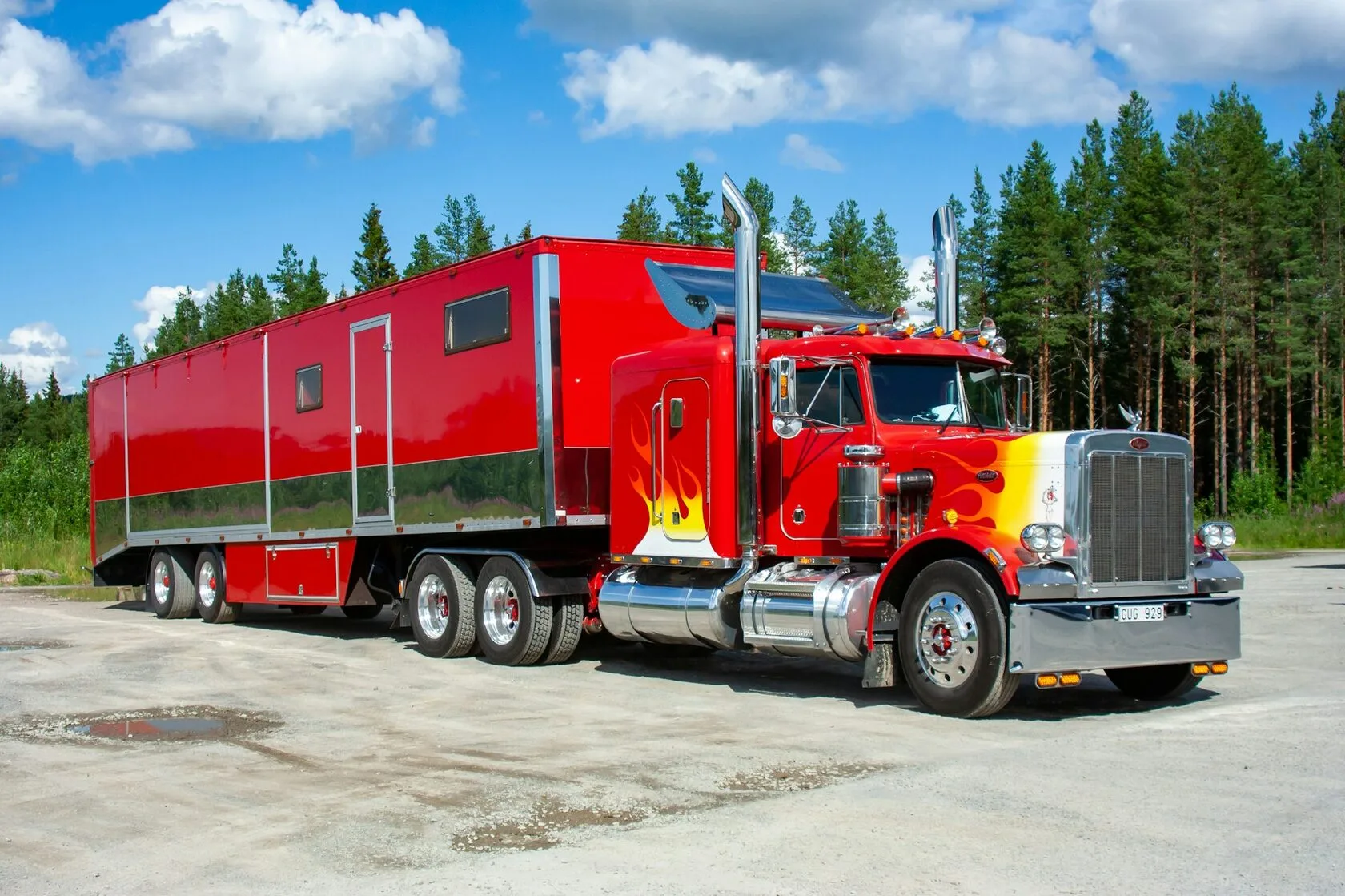
Are you considering opening a trucking business? Or looking for ways to grow your existing company? The general freight market grew nearly 10% in 2022 alone, and industry experts forecast further expansion. That makes right now an ideal time to explore opportunities in trucking.
Making the most of what the trucking industry offers depends on protecting your net income. The average tax rate entrepreneurs can expect is close to 20%, which reduces your income directly. That means for every $100 you earn, you'll see only $80 on your account at year end — before other business expenses.
The good news: there are ways to minimize your tax burden, and one of them is choosing a favorable business structure. In this article we'll look at the three most common business structures in trucking, general tax-reduction strategies and the hidden tax benefits you should be using. Comparing Sole Proprietorships, Limited Liability Companies (LLCs) and S-Corporations (S-Corp) — while there are many business structures, we've narrowed the list to the three that fit truck drivers best. Let's look at each in more detail. ** Sole Proprietorship ** A sole proprietorship is the simplest form of business organization. You don't need a separate taxpayer identification number (EIN) and you don't file a business tax return. Instead, all profits or losses are reported directly on your individual tax return on Schedule C. That can make running your trucking business easier, but it simultaneously exposes you to double taxation.
Prepared by EDEAL.AI
The first type of tax you'll pay is self-employment tax on your net income. Net income is your total business income minus allowable business deductions. The tax rate is 15.3% and includes Social Security and Medicare taxes paid by both employer and employee. However, you can claim a tax credit for the employer's share, which is 7.65% of the tax. The second type of tax you'll pay is regular income tax. This tax depends on your bracket and can range from 0% to 37%.
In addition, a sole proprietorship structure can limit your options for raising capital and for business succession. You are the business. If something happens to you, the business effectively ceases to exist. You also can't bring on partners or additional owners. Another reason some trucking companies avoid sole proprietorship is personal liability. The IRS and many courts treat you and your business as a single entity. If the business faces a lawsuit, the court can reach your personal assets to satisfy a judgment. Still, sole proprietorship can be an excellent solution for small companies in their early stages.
Limited Liability Company (LLC)
Next on the complexity scale is the limited liability company, known as an LLC. There are two main types of LLC: single-member and multi-member. Single-member LLCs are taxed similarly to sole proprietors. However, there is a small separation between you and the business. Such LLCs must register in the state where they operate, but they don't need to obtain an EIN or file a separate tax return.
By contrast, multi-member LLCs require a separate EIN and a business tax return filing. One advantage of multi-member LLCs is the ability to bring in additional members. For example, you and a friend get tired of working for another trucking company. Instead of starting a business alone, you can form a multi-member LLC where each of you receives half the profits.
Maintaining an LLC takes more work. Every year you'll need to file a business tax return. LLC income flows through to the owner, however. That means any income you earn is taxed at ordinary income tax rates on your individual return via Schedule K-1. No self-employment tax is paid on the profit.
Prepared by EDEAL.AI
There are several drawbacks to an LLC. First, all distributions and decisions must be agreed on by all members, which can limit your decision-making ability. Additionally, detailed provisions must govern distribution of income and losses and circumstances related to succession. These factors can increase your initial legal costs.
S-Corporation (S-Corp)
S-corporations combine features of LLCs and C-corporations. Like LLCs, S-corporations pass all income through to shareholders via Schedule K-1. This provides an opportunity to reduce self-employment taxes and maintain flexibility around ownership changes. S-corporations require a business tax return but do not allow shareholders to pay taxes at the corporate level the way C-corporations do.
S-corporations provide full separation between business and personal assets, which is an advantage if your company is ever sued. The main drawback, however, is the maintenance requirements. In addition to the business tax return, you'll need to follow strict procedures. For example, you need to carefully monitor your shareholders because an S-corp cannot have shareholders who are trusts.
Choosing the right option — so which one to pick? First and foremost you need to evaluate how you want to be taxed. Is the convenience of filing Schedule C on your individual tax return worth paying both regular income tax and self-employment tax? Are you planning to bring in partners or additional shareholders? If you don't need capital from additional shareholders and you're looking for a simple, quick setup, sole proprietorship may be right for you.
However, if you're looking for greater separation between business and personal assets, self-employment tax savings, business succession options and expanded capital-raising capabilities, an LLC or S-corporation may be more appropriate. Keep in mind that a multi-member LLC requires two members to form the business, while an S-corporation requires only one owner. If you don't have another person you'd like to start a business with, an S-corp will be the most preferable option.
Prepared by EDEAL.AI
Tax reduction strategies
A common misconception among business owners is that taxes are calculated on gross income. That's not the case. Taxes are calculated based on net income. To minimize the tax burden, you need to use every business deduction available.
The IRS limits what qualifies as a deductible business expense. For an expense to be deductible it must be ordinary and necessary. That means sunscreen for a Florida vacation won't be recognized as a deduction for your trucking business. In addition, expenses must be reasonable. Is it reasonable to pay someone $5,000 to wash your truck? Probably not. Here are some general deductions worth paying attention to:
Tax hacks
Now that we've covered business structures and general tax deductions, let's look at less common tax hacks. First, let's distinguish a deduction from a credit. A tax deduction reduces your taxable income, while a tax credit reduces your tax bill dollar for dollar. That makes credits more valuable for your tax situation. For example, say you're taxed at 20%. You have gross income of $1,000, qualified deductions of $250 and a credit of $125. Your taxable income is $750 ($1,000 − $250). This creates a tax liability of $150 ($750 × 20%). Your credit brings taxes owed down to just $25 ($150 − $125). See the power of credits? Let's look at some credits and unusual tax hacks you can implement in your trucking business.
Energy efficiency credits — the Inflation Reduction Act of 2022 introduced many tax incentives for vehicles. If your truck meets certain energy efficiency requirements you may qualify for a credit.
Qualified Business Income Deduction — this is an immediate 20% reduction of your taxable income. Sole proprietorships, LLCs and S-corporations all qualify for this deduction.
Home office deduction — this deduction applies only to sole proprietors. If you have a room in your home that serves as an office, you can deduct a share of mortgage interest, property taxes, utilities and insurance. Retirement deductions — even though you're your own boss, it doesn't hurt to start saving for retirement. Most retirement plans have matching employer contributions. That match is fully deductible.
Mobile phone — running a business from your mobile phone or other personal devices makes the expense deductible.
Employing your children — a tax hack many trucking business owners overlook is paying their children. By hiring your children to wash your truck you get a tax deduction for the wages paid. In addition, you don't have to pay FICA taxes on the wages if your children are under 18.
Can you take advantage of any of these tax hacks? To find the tax-planning strategies that work best for your business, reach out to a qualified tax specialist today. In this article we covered a lot — from tax advantages of various business structures and common deductions to hidden tax hacks. Sorting through this information and applying it properly to your trucking business can feel overwhelming, which is why many trucking business owners turn to our team at Edeal Inc.
We have extensive experience in the trucking industry, which lets us develop personalized tax-planning strategies that help you save money year after year. Contact us to schedule a consultation with one of our certified accountants today.
Making the most of what the trucking industry offers depends on protecting your net income. The average tax rate entrepreneurs can expect is close to 20%, which reduces your income directly. That means for every $100 you earn, you'll see only $80 on your account at year end — before other business expenses.
The good news: there are ways to minimize your tax burden, and one of them is choosing a favorable business structure. In this article we'll look at the three most common business structures in trucking, general tax-reduction strategies and the hidden tax benefits you should be using. Comparing Sole Proprietorships, Limited Liability Companies (LLCs) and S-Corporations (S-Corp) — while there are many business structures, we've narrowed the list to the three that fit truck drivers best. Let's look at each in more detail. ** Sole Proprietorship ** A sole proprietorship is the simplest form of business organization. You don't need a separate taxpayer identification number (EIN) and you don't file a business tax return. Instead, all profits or losses are reported directly on your individual tax return on Schedule C. That can make running your trucking business easier, but it simultaneously exposes you to double taxation.
Prepared by EDEAL.AI
The first type of tax you'll pay is self-employment tax on your net income. Net income is your total business income minus allowable business deductions. The tax rate is 15.3% and includes Social Security and Medicare taxes paid by both employer and employee. However, you can claim a tax credit for the employer's share, which is 7.65% of the tax. The second type of tax you'll pay is regular income tax. This tax depends on your bracket and can range from 0% to 37%.
In addition, a sole proprietorship structure can limit your options for raising capital and for business succession. You are the business. If something happens to you, the business effectively ceases to exist. You also can't bring on partners or additional owners. Another reason some trucking companies avoid sole proprietorship is personal liability. The IRS and many courts treat you and your business as a single entity. If the business faces a lawsuit, the court can reach your personal assets to satisfy a judgment. Still, sole proprietorship can be an excellent solution for small companies in their early stages.
Limited Liability Company (LLC)
Next on the complexity scale is the limited liability company, known as an LLC. There are two main types of LLC: single-member and multi-member. Single-member LLCs are taxed similarly to sole proprietors. However, there is a small separation between you and the business. Such LLCs must register in the state where they operate, but they don't need to obtain an EIN or file a separate tax return.
By contrast, multi-member LLCs require a separate EIN and a business tax return filing. One advantage of multi-member LLCs is the ability to bring in additional members. For example, you and a friend get tired of working for another trucking company. Instead of starting a business alone, you can form a multi-member LLC where each of you receives half the profits.
Maintaining an LLC takes more work. Every year you'll need to file a business tax return. LLC income flows through to the owner, however. That means any income you earn is taxed at ordinary income tax rates on your individual return via Schedule K-1. No self-employment tax is paid on the profit.
Prepared by EDEAL.AI
There are several drawbacks to an LLC. First, all distributions and decisions must be agreed on by all members, which can limit your decision-making ability. Additionally, detailed provisions must govern distribution of income and losses and circumstances related to succession. These factors can increase your initial legal costs.
S-Corporation (S-Corp)
S-corporations combine features of LLCs and C-corporations. Like LLCs, S-corporations pass all income through to shareholders via Schedule K-1. This provides an opportunity to reduce self-employment taxes and maintain flexibility around ownership changes. S-corporations require a business tax return but do not allow shareholders to pay taxes at the corporate level the way C-corporations do.
S-corporations provide full separation between business and personal assets, which is an advantage if your company is ever sued. The main drawback, however, is the maintenance requirements. In addition to the business tax return, you'll need to follow strict procedures. For example, you need to carefully monitor your shareholders because an S-corp cannot have shareholders who are trusts.
Choosing the right option — so which one to pick? First and foremost you need to evaluate how you want to be taxed. Is the convenience of filing Schedule C on your individual tax return worth paying both regular income tax and self-employment tax? Are you planning to bring in partners or additional shareholders? If you don't need capital from additional shareholders and you're looking for a simple, quick setup, sole proprietorship may be right for you.
However, if you're looking for greater separation between business and personal assets, self-employment tax savings, business succession options and expanded capital-raising capabilities, an LLC or S-corporation may be more appropriate. Keep in mind that a multi-member LLC requires two members to form the business, while an S-corporation requires only one owner. If you don't have another person you'd like to start a business with, an S-corp will be the most preferable option.
Prepared by EDEAL.AI
Tax reduction strategies
A common misconception among business owners is that taxes are calculated on gross income. That's not the case. Taxes are calculated based on net income. To minimize the tax burden, you need to use every business deduction available.
The IRS limits what qualifies as a deductible business expense. For an expense to be deductible it must be ordinary and necessary. That means sunscreen for a Florida vacation won't be recognized as a deduction for your trucking business. In addition, expenses must be reasonable. Is it reasonable to pay someone $5,000 to wash your truck? Probably not. Here are some general deductions worth paying attention to:
- Fuel — this is the most common type of expense in a trucking business. Every time you fill the tank, keep the receipt so you can deduct the expense on your tax return. Only business fuel is deductible.
- Repairs and maintenance — any expenses related to maintaining your truck are deductions: oil changes, new tires or axle repairs.
- Supplies — cargo straps, motor oil or any other item used primarily for trucking purposes are deductible.
- Depreciation — in most cases your truck and any trailers will depreciate over their useful life, typically five years. For a $100,000 truck you can take a $20,000 deduction in each of the next five years.
- Meals — meals on the road are deductible. However, the IRS limits the deduction to 50%. Entertainment like going to a movie on the road is not deductible.
- Insurance — insurance on your truck is fully deductible.
- Truck loans — buying a truck can be expensive. If you finance a truck loan, the interest paid is a qualified business deduction.
- Bank fees — since you run a legitimate business, you should have a separate business bank account. Bank fees on this account are deductible on your tax return.
- Professional fees — expenses related to preparing the business tax return, setting up your business or performing general accounting can be used to reduce taxable income.
- Travel — if you took a long route, travel expenses like a hotel are a business deduction.
- Continuing education — training on best trucking practices or any other course related to trucking counts as a business deduction.
- Clothing — trucking companies with uniforms can deduct the cost of clothing.
- Dues and subscriptions — amounts paid to maintain professional accreditation or a subscription are qualified business expenses if they relate to the trucking industry.
Tax hacks
Now that we've covered business structures and general tax deductions, let's look at less common tax hacks. First, let's distinguish a deduction from a credit. A tax deduction reduces your taxable income, while a tax credit reduces your tax bill dollar for dollar. That makes credits more valuable for your tax situation. For example, say you're taxed at 20%. You have gross income of $1,000, qualified deductions of $250 and a credit of $125. Your taxable income is $750 ($1,000 − $250). This creates a tax liability of $150 ($750 × 20%). Your credit brings taxes owed down to just $25 ($150 − $125). See the power of credits? Let's look at some credits and unusual tax hacks you can implement in your trucking business.
Energy efficiency credits — the Inflation Reduction Act of 2022 introduced many tax incentives for vehicles. If your truck meets certain energy efficiency requirements you may qualify for a credit.
Qualified Business Income Deduction — this is an immediate 20% reduction of your taxable income. Sole proprietorships, LLCs and S-corporations all qualify for this deduction.
Home office deduction — this deduction applies only to sole proprietors. If you have a room in your home that serves as an office, you can deduct a share of mortgage interest, property taxes, utilities and insurance. Retirement deductions — even though you're your own boss, it doesn't hurt to start saving for retirement. Most retirement plans have matching employer contributions. That match is fully deductible.
Mobile phone — running a business from your mobile phone or other personal devices makes the expense deductible.
Employing your children — a tax hack many trucking business owners overlook is paying their children. By hiring your children to wash your truck you get a tax deduction for the wages paid. In addition, you don't have to pay FICA taxes on the wages if your children are under 18.
Can you take advantage of any of these tax hacks? To find the tax-planning strategies that work best for your business, reach out to a qualified tax specialist today. In this article we covered a lot — from tax advantages of various business structures and common deductions to hidden tax hacks. Sorting through this information and applying it properly to your trucking business can feel overwhelming, which is why many trucking business owners turn to our team at Edeal Inc.
We have extensive experience in the trucking industry, which lets us develop personalized tax-planning strategies that help you save money year after year. Contact us to schedule a consultation with one of our certified accountants today.
Worried about IRS filings for a foreign-owned LLC? Edeal takes care of US tax compliance.