
"Probably fine" is a bad strategy
This is one of the nastiest features of the US system. A company can exist, operate, take payments, pay contractors, open accounts — while somewhere in the background a risk is already building up. A missed report. The wrong registered agent. A state deadline. An IRS form. A status the owner finds out about too late.
We've seen this many times at Edeal. The founder is sure everything is under control because the business is running and the money is coming in. But a company's standing before the state and the IRS is a separate layer that lives by its own rules — and does not depend on whether you have revenue or not.
"Probably fine" is not an assessment, it's a hope. And when it comes to a US company, hope is a poor substitute for a fact.
How hidden risk builds up in the US
The problem almost never arrives as one big event. It accumulates from small things, each of which looks insignificant on its own.
The owner moved — but the address with the registered agent stayed old. The state sent a request to file an annual report — the letter went to an address no one checks. An IRS form deadline arrived — but the founder only learned about the form from an article online. The company was moved to inactive status — while he thought it was simply "dormant."
Each of these bricks sits quietly. But together they turn into a situation you later have to restore rather than check — slower, more expensive and more stressful.
Why owners find out too late
The main reason is simple: the founder has no single picture. They don't know the names of the forms, don't know the exact deadlines, and don't always understand what their state actually requires.
And the choice, in essence, is between three options. Trust the accountant and hope they see the whole picture. Gather information from articles online, half of which are outdated or not about your case. Or live with the feeling that "it's probably fine" — until the letter arrives.
None of these gives you what you actually need: a calm, honest answer to "what's going on with my company right now."
What happens when you find out late
The difference between "checking" and "restoring" is usually a difference in time and stress. While a risk is small, you close it with a single action: update an address, file one report, fix a data point. Boring and fast.
When the problem is discovered late, everything changes. The company can end up in an inactive status that stalls a bank or a payment provider. The state may require a restoration rather than just the next report. A chain appears — "first this, then that" — where each step pulls the next along.
I've seen a single missed item turn into weeks of correspondence and extra costs — not because the situation was frightening, but because it went unnoticed for too long. An early check exists precisely to catch a risk while it's still at the "boring and fast" stage, before it grows consequences.
What we decided to do
So we did what we'd wanted to do for a long time: we opened part of our internal expertise for free, to everyone. Now any owner of a US company can go to edeal.ai, fill out a short form and receive a personal dossier for their company.
For me this isn't just a new feature on the site. It's a step toward Edeal's bigger idea: a founder shouldn't run a company blind. They should have a clear map of risks, deadlines and next actions — not an anxious folder of documents they only return to once something has already happened.
How the check works
Under the hood it's what we normally do by hand for clients, only automatically and fast.
We reconcile your data against official state registries. We analyze dozens of parameters. We collect deadlines, look at the company type and its status — and turn all of it into a clear report. Not a table of jargon that's impossible to read, but plain language: where everything is fine, what's worth checking, and what's better not to postpone.
The report arrives by email within 20 minutes. All we need from you is a short form — you don't have to know the names of the forms or understand your state's requirements in advance. That's the whole point: the tool takes on the part where people usually get lost.
What exactly we analyze — and why
Since you're reading closely, let me show honestly what happens inside. The check runs from two sides: part of the data comes from your short form, part is reconciled against official state registries and IRS requirements. Then all of it is sorted into several areas.
What we take from the form and the registry
- Company name and state. We reconcile your company with the state business registry: status, registration date, agent. It's the starting point — whether the company is "in order" from the state's point of view.
- Month and year of registration. Deadlines are calculated from the date: in many states the annual report is tied to the registration month, and the first federal return to the first tax year.
- Company type (LLC, Corporation, Partnership); for an LLC — single or multiple owners; for a Corporation — whether an S-election is in effect. The type determines which returns the IRS expects and when.
- Who registered the company. When a third party registers it, the documents sometimes list the wrong owner or number — worth checking before the IRS does.
- Registered agent and renewal date. An agent is mandatory in every state; a lapsed renewal means losing the address for official notices, and good standing after it.
- Owner's tax status and 25%+ foreign ownership. This drives the set of forms: foreign ownership triggers separate information reporting to the IRS.
- Whether there was financial activity. A "zero" company isn't automatically exempt from reporting — the set of forms is simply different.
- Selling goods and channels (own site, marketplaces, offline) and how sales tax is handled.
- Federal filing status for last year — the key point: it determines whether risk has already accumulated.
- Owner payouts and bookkeeping, employees and contractors. How money movement is documented and whether there are employer-side obligations.
The zones the result is sorted into
The engine then turns this into a clear picture across six areas.
- Structure and ownership. Who's listed as owner, whose number the EIN was issued under, whether the company type is correct, whether there are incompatible combinations (for example, an S-Corporation with a non-resident shareholder), and whether the state-registry status is good.
- Federal reporting. Whether last year's return was filed, whether foreign-ownership information reporting is required, whether there's an unresolved IRS notice.
- State reporting. Annual reports and franchise or minimum state taxes, deadlines tied to your state and registration date, and states where no periodic report is required at all.
- Sales tax. Whether an obligation arose from selling goods (economic nexus), whether tax is being collected, and who reports it — you or the platform.
- Owner payouts and bookkeeping. Whether money moves without records, whether personal and corporate expenses are mixed, whether payouts to the owner are properly documented.
- Employees and contractors. Whether payroll is set up, whether forms for US and foreign contractors were filed.
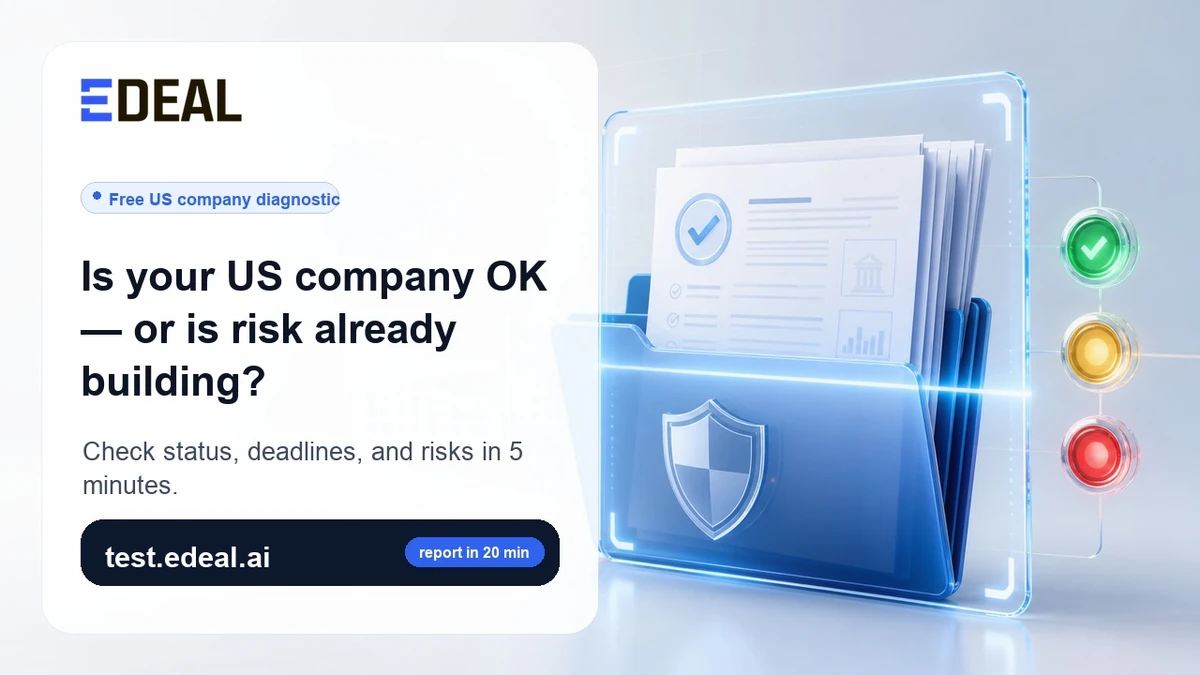
For each item you see a color: green — fine, yellow — worth a look, red — better not to postpone. Plus a personal calendar of upcoming deadlines. We deliberately don't put scary numbers in the report — exact figures and how they apply to your situation are discussed on a consultation with a person.
Check your company for free → edeal.ai
A short form — and a personal dossier for your company by email within 20 minutes. No payment, no commitment.
What you'll see in the dossier
The report is built so you can use it right away rather than decode it. In essence, it's a map with three zones.
- Where everything is fine. Parameters where your company is in order — so you don't spend attention on what already works.
- What's worth checking. Places where there's no emergency but a reason to look closer: data that may have gone stale, or requirements about to become relevant.
- What's better not to postpone. Things that already need action — an approaching deadline or a discrepancy that's cheaper to close now than to untangle later.
It's not a verdict and not an attempt to scare you. It's a reference point for making a calm decision — on your own or together with us.
Why we're doing this
We've accumulated a lot of knowledge from real client cases: complex situations with states, company restorations, tax questions, the typical mistakes business owners make. That knowledge used to live inside the team and reach only those who came to us.
Now part of it is available to everyone, free. It matters to me that a founder can at least see their own risk map — even if they then decide to handle it themselves. And if they want us to help close what it found, we're right here. But the first step, an honest diagnosis, should be something a person can take with no barriers.
To me, that's how proper business support should work. Not "bring the documents when it hurts," but a calm, regular look at the company's standing — so decisions are made ahead of time and with a clear head, not in firefighting mode. A free check is a way to give that look to everyone, not only active clients.
Frequently asked questions
How much does the check cost?
Nothing. The check on edeal.ai is free: you fill out a short form and receive a personal dossier for your company.
What exactly gets checked?
Your data is reconciled against official state registries, and dozens of parameters are analyzed: company type, status, deadlines and state requirements.
How fast does the report arrive?
By email within 20 minutes of completing the form.
What will I see in the report?
A clear map: where everything is fine, what's worth checking, and what's better not to postpone — a guide to risks and next steps.
Does the check work for an inactive company?
Yes. In fact, dormant companies are exactly where unnoticed things pile up most — status, reports, agent details. The check shows what's actually going on.
Don't run your company blind
If you have a US company, you deserve a simple honest answer to "is everything fine." Not "probably," but based on facts, reconciled with the registries and with a clear list of what to look at.
Check your company — it's free and takes a few minutes. The report with your risk map arrives by email within 20 minutes.
Check your company in 20 minutes
A free personal dossier for your US company: state-registry reconciliation, deadlines and a clear list of actions. Fill out a short form — the report arrives by email.