
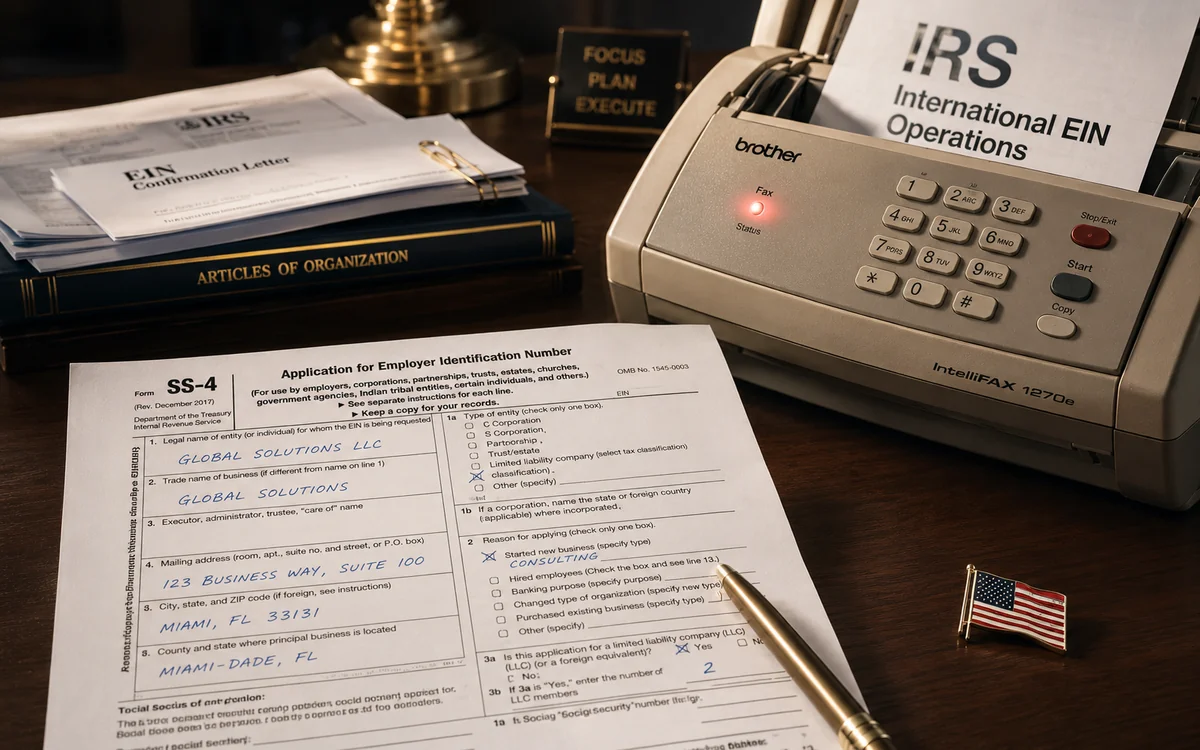
This piece exists so you can sit down with Form SS-4 and fill it correctly on the first attempt. The most common mistakes — incorrect entries on lines 7b, 9a, and 10 — are exactly what causes IRS to reject the application or assign an EIN that later fails at a bank. Let's go line by line.
What an EIN is and why a non-resident needs it
An EIN is a nine-digit number in the format 12-3456789, assigned by the IRS to a business entity for tax filing and reporting. As the IRS puts it: "the information you provide on this form will establish your business tax account." Think of it as a federal tax ID for your company. Without it, your LLC formally exists, but it can't operate normally.
For a non-resident who owns a US LLC, EIN is critical for three reasons:
- Bank account. Mercury, Wise, Relay, and any US bank require an EIN to open a business account. Without it, they won't even start KYC.
- Payment processors. Stripe, PayPal, Square — all ask for an EIN during onboarding.
- Mandatory Form 5472 filing. If you own a foreign-owned single-member LLC (non-resident holds 100%), the IRS requires Form 5472 annually — and that requires an EIN. The Instructions state this directly: "where a U.S. disregarded entity is wholly owned by a foreign person, to file information returns on Form 5472."
Getting an EIN is free — the IRS charges nothing for it. If a service offers to "get you an EIN for $300," you're paying for their form-filling labor, not for the number itself.
Important: EIN is not a substitute for SSN or ITIN. From the Instructions: "An EIN is for use in connection with your business activities only. Don't use your EIN in place of your social security number (SSN) or individual taxpayer identification number (ITIN)." Personal taxes (e.g., Form 1040-NR) go under an ITIN. Business operations go under an EIN.
Why a non-resident can't apply online
The most common question on a first consultation: "Can I just apply through IRS.gov/EIN?" Short answer — no. The Instructions are explicit:
"If you have NO legal residence, principal place of business, or principal office or agency in the United States or U.S. territories, you can't use the online application to obtain an EIN. Please use one of the other methods to apply."
And separately, on responsible party: "The principal officer, general partner, grantor, owner, trustor, etc., must have a valid taxpayer identification number (SSN, EIN, or ITIN) in order to use the online application."
Two conditions — and both cut a non-resident off from the online channel. No US physical presence + no SSN/ITIN = no online filing. It's not a bug, it's IRS policy, and there's no workaround.
The good news: you don't need the online channel. The other three work.
Three working channels
From the Instructions: applications can be submitted "by telephone (only for applicants outside of the United States or U.S. territories), by fax, or by mail." Use only one channel per entity — parallel submissions create duplicate EINs that you'll then have to untangle.
Channel 1. Fax — the fastest method available to non-residents
Fax processing time is generally about 4 business days ("generally within 4 business days"). You complete Form SS-4, sign it, and send it by fax. The IRS faxes the EIN back — so you must include your return fax number on the form.
IRS fax numbers for non-residents (these are the exact, current numbers from the Rev. 12/2025 Instructions):
- From outside the US: 304-707-9471
- From within the US (if you have no legal residence in any of the 50 states or DC): 855-215-1627
Fax-TIN runs 24/7. For most clients outside the US, this is the most practical channel: services like HelloFax, FaxBurner, or RingCentral let you send a fax straight from your browser for a couple of dollars, no physical machine needed.
Channel 2. Mail — slow, but lowest friction
Mail processing — approximately 4 weeks. IRS recommends submitting "at least 4 to 5 weeks before you will need an EIN," accounting for delivery time.
International address (from the Instructions):
Internal Revenue Service
Attn: EIN International Operation
Cincinnati, OH 45999
For checking application status by mail — 800-829-4933. That number is for status only, not for submission.
Channel 3. Phone — instant, but you need to handle the call in English
From the Instructions: "If you have NO legal residence, principal place of business, or principal office or agency in the United States or U.S. territories, you may call 267-941-1099 (not a toll-free number), 6:00 a.m. to 11:00 p.m. (Eastern time), Monday through Friday, to obtain an EIN."
Call parameters:
- Number: 267-941-1099 (not toll-free, international call rates apply)
- Hours: 6:00 AM – 11:00 PM Eastern Time
- Days: Monday through Friday
The key thing: complete Form SS-4 before calling. The IRS agent walks through the lines in order. The EIN is assigned during the call — they read it to you, you write it in the top-right corner of the form and sign it. After the call, the IRS may ask you to fax the signed form within 24 hours.
Domestic taxpayers haven't been able to get EINs by phone since 2014 — this channel exists only for international applicants.
Form SS-4 line by line for a foreign-owned LLC
This is the most important section. Pull the latest form from IRS.gov (Form SS-4, Rev. December 2025) and follow along. For lines that don't apply, the IRS recommends entering "N/A" ("Generally, enter N/A on the lines that don't apply").
Line 1 — Legal name of entity
The legal name of the LLC exactly as it appears in the Articles of Organization, including the "LLC" suffix. No abbreviations. If your formation documents say "Lighthouse Trade LLC", write exactly that — not "Lighthouse Trade, LLC" or "LightHouse Trade LLC".
Line 2 — Trade name (DBA)
Filled in only if you have a DBA different from the legal name. Critical IRS warning: "To prevent processing delays and errors, use only the legal name (or the trade name) on all tax returns." Mixing the two across different returns is a frequent cause of processing delays.
Lines 4a–4b and 5a–5b — addresses
Mailing address (4a–4b) — where IRS will send correspondence. If the address is outside the US, IRS requires: city, state or province, postal code, and the full country name without abbreviations (this requirement is repeated twice in the Instructions).
Street address (5a–5b) — only if the physical address differs from mailing. P.O. boxes are not allowed in lines 5a–5b.
Line 6 — County and state where principal business is located
For a US LLC registered by a non-resident, this is usually the county and state of LLC formation (Wyoming, Delaware, New Mexico, and so on).
Line 7a — Name of responsible party
Full name of the LLC owner (first name, middle initial, last name). Responsible party as defined by IRS — "the person who ultimately owns or controls the entity." This must be an individual ("the responsible party must be an individual, that is, a natural person, not an entity"), not another company.
Line 7b — SSN / ITIN / EIN of responsible party (critical line)
This is the line where most non-residents go wrong. Direct citation from the Instructions:
"Enter 'foreign' or N/A on line 7b if the responsible party doesn't have and is ineligible to obtain an SSN or ITIN. An entry is required."
Translation: write "foreign" or "N/A" — IRS accepts both. The key thing is don't leave it blank. A blank Line 7b means the form gets returned.
Lines 8a–8c — LLC information
Line 8a: "Yes" (this is an LLC). Line 8b: number of LLC members — for a single-member LLC, enter "1". Line 8c: whether the LLC is US-organized — yes, if your LLC is registered in Wyoming, Delaware, etc.
Line 9a — Type of entity (second critical line)
This is the second line non-residents often get wrong. For a typical foreign-owned single-member LLC that will be filing Form 5472, IRS gives a clear instruction:
"If the disregarded entity is requesting an EIN for purposes of filing Form 5472, as required under section 6038A for a U.S. disregarded entity that is wholly owned by a foreign person, check the Other box for line 9a and write 'Foreign-owned U.S. disregarded entity-Form 5472.'"
So: check "Other" and write "Foreign-owned U.S. disregarded entity-Form 5472".
Line 10 — Reason for applying (third critical line)
IRS explicitly forbids "N/A" in Line 10: "Check only one box. Don't enter N/A. A selection is required."
For a foreign-owned SMLLC required to file Form 5472, IRS again gives the exact wording:
"A foreign-owned U.S. disregarded entity required to file Form 5472 should enter 'Foreign-owned U.S. disregarded entity filing Form 5472' in the space provided."
So: check "Other" and write "Foreign-owned U.S. disregarded entity filing Form 5472".
Line 11 — Date business started
For foreign applicants, IRS clarifies: "For foreign applicants, this is the date you began or acquired a business in the United States." The LLC formation date in the state is usually that date.
Line 12 — Closing month of accounting year
For most LLCs, the default is December (calendar year). Unless you have a specific reason to choose a fiscal year, leave it as "December" or "12".
Lines 13–15 — Employees
If you have no employees — Line 13 zeros (-0-), Line 14 skipped, Line 15 "N/A." If you plan to hire in the US, IRS notes for Line 15: "For foreign applicants, this is the date you began to pay wages in the United States."
Lines 16–17 — Principal activity
Line 16 — check one of: Construction, Manufacturing, Retail, Wholesale, Transportation, Real estate, Health care, Accommodation & food services, Finance & insurance, or Other. Line 17 — the detail (for example, for Retail: "Online sales of consumer electronics via Amazon"). Line 17 entry is required.
Line 18 — Previous EIN
If the entity had an EIN before — "Yes" and the previous number. If not — "No". IRS limit: no more than one EIN per responsible party per day across all channels (online, phone, fax, mail).
Signature and Third Party Designee
The Third Party Designee section is filled only if you want to authorize a third party (a tax consultant, our team, etc.) to receive the EIN on your behalf and answer IRS questions about the form. The designee's authority terminates once the EIN is assigned.
On signing: "Foreign applicants may have any duly authorized person sign Form SS-4." A non-resident owner of an SMLLC, as a duly authorized member, can sign the form from abroad. A scanned signature is acceptable — IRS accepts the fillable PDF (Form SS-4 from IRS.gov is "a fillable form and, when completed, is suitable for faxing or mailing to the IRS").
Book a consultation with Edeal → book.edeal.ai
If you'd like someone to walk through Form SS-4 with you and submit it correctly the first time, we have a dedicated team for it. More: US company formation and support.
Comparison of the three channels
| Channel | Timeline | Friction | When to use |
|---|---|---|---|
| Fax | ~4 business days | Need a fax-out service and a return fax to receive the EIN | Most practical for most non-residents |
| ~4 weeks | International delivery in both directions can add weeks | If the EIN isn't urgent and you don't want to deal with fax | |
| Phone | Instant during the call | Conversational English with IRS, restricted hours | If you're comfortable in English and want the number immediately |
What to do after receiving the EIN
EIN in hand isn't the finish line — it's the start of setup. In the first 7–14 days it makes sense to:
- Open a business bank account. Mercury, Wise, or Relay accept EINs immediately after assignment — the IRS confirmation comes in the form of CP 575 (this is the document banks usually ask for as proof of EIN). For details on 2026 bank requirements, see our LLC address and bank KYC guide.
- Connect Stripe. If you plan to accept online payments.
- Set a reminder for Form 5472. For a foreign-owned SMLLC, Form 5472 plus a pro forma 1120 is filed annually, and the penalty for missing it is steep. A dedicated piece on this form is coming to the blog.
One more detail: if entity information changes (address, responsible party), you must notify IRS via Form 8822-B within 60 days. This is a Treasury Regulations requirement that's regularly missed.
Common mistakes and IRS rejections
Over six years working with non-resident founders, we see the same patterns. A few are worth naming out loud — they cost at least four weeks of re-application.
Submitting through multiple channels at once. "Use only one method for each entity so you don't receive more than one EIN for an entity." If you faxed and didn't see a response — don't also mail it. You'll get two EINs on the same company, and then you have to write to IRS to cancel one.
"N/A" in Line 10. IRS explicitly forbids it: "Don't enter N/A. A selection is required." Automatic return of the form.
Empty Line 7b. An entry is required — "foreign" or "N/A". A blank line gets the form returned.
Using someone else's SSN. Sometimes non-residents write an American friend's or relative's SSN in Line 7b. This creates legal confusion about responsible party — under IRS records, your friend, not you, becomes the responsible party. Don't do this. "Foreign" or "N/A" is the correct path.
Submitting SS-4 before the LLC is registered with the state. EIN is applied for AFTER the LLC is registered in Wyoming / Delaware / etc. If you apply before, IRS may assign an EIN, but the bank will still require proof of LLC formation, and you'll have to redo everything — which is why we handle end-to-end company registration and the EIN in the right order.
Abbreviating the country name. "Don't abbreviate the country name" — repeated twice in the Instructions. "Russia," not "RU." "Kazakhstan," not "KZ." "United Arab Emirates," not "UAE."
P.O. box in Line 5a. Not allowed. Only a physical address or a mailing service with a real physical premises.
If a return is due before the EIN arrives
Sometimes a tax return deadline arrives before IRS assigns the EIN. IRS has a clear protocol for that: "If you don't have an EIN by the time a return is due, write 'Applied For' and the date you applied in the space shown for the number." Write "Applied For" + the SS-4 submission date in the EIN field. Never substitute your SSN or ITIN in the EIN field.
Need help filing SS-4 without rejection?
At Edeal we help international founders get EINs for foreign-owned LLCs — we run this procedure with clients every week, by fax or via Third Party Designee. Typical turnaround from form-fill to EIN in hand is 4–7 business days.
- Instructions for Form SS-4 (Rev. December 2025) — IRS.gov
- Form SS-4 PDF (Rev. December 2025) — IRS.gov
- Employer Identification Number — IRS.gov
- U.S. Taxpayer Identification Number Requirement — IRS.gov