
Why This Market Doesn't Collapse Even in a Recession
Someone once told me: "Making money on kids is sacred." She meant a simple thing: parents cut spending on themselves, but almost never on their children.
Despite all the gadgets, AI, endless content — kids still want to run, scream, and make friends in person. COVID made it especially visible: when offline spaces shut down, parents were literally counting the days to reopening.
The kids' activities market is growing. Average ticket is going up. Parents' "wants" are increasing, not decreasing. The business of socializing children is not a trend; it's a long-term market with very durable demand.
A kids entertainment center is one of the few businesses where a recession doesn't kill demand, it reallocates it. Parents stop spending on themselves, but almost never on the kids.
What I Saw as an Entrepreneur, Not as a Dad
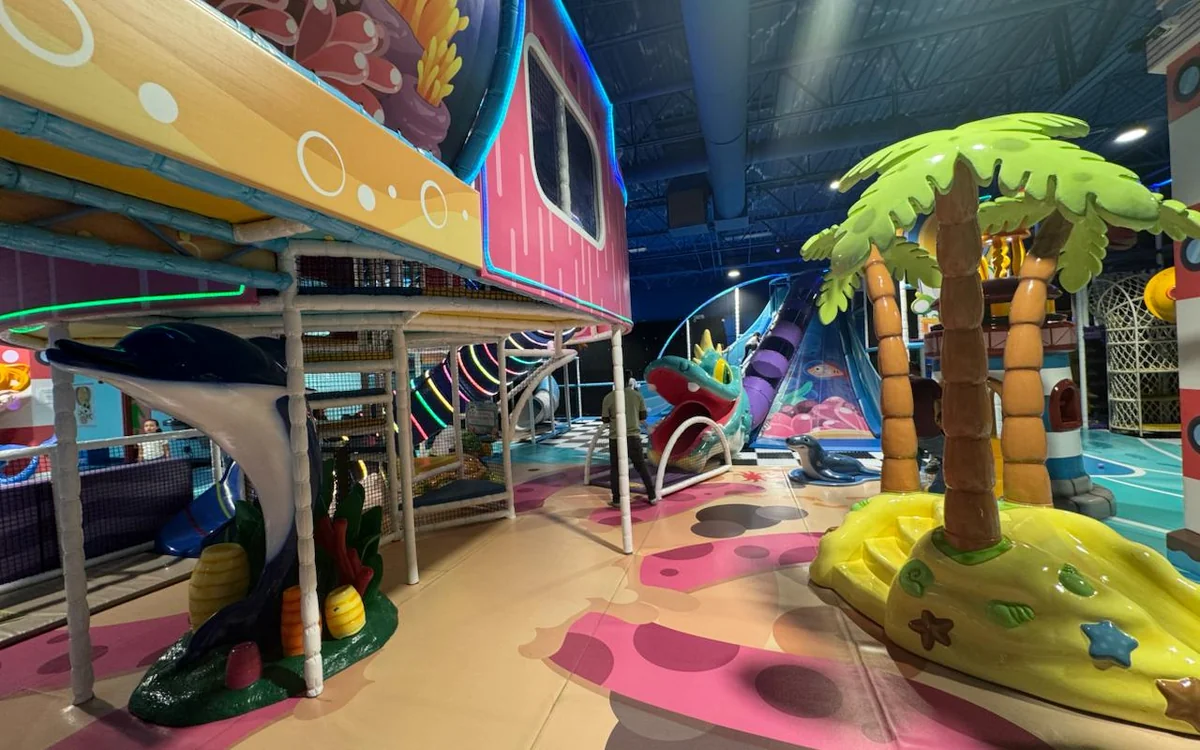
Three hours is enough to read a business. I sat and watched.
The staff was friendly but couldn't sell at all. Nobody offered a membership. Nobody asked for contact info. Nobody mentioned a discount for a return visit. Over those three hours I watched several families say goodbye, walk out the door, and that's it. No "come back Wednesday, we have 20% off," no "leave your number, we'll send you the promo." People come, pay once, and leave forever — unless they remember to come back on their own.
The average family ticket I observed was around $20–35 per visit: café, entry, a couple of attractions. And yet not a single staff member offered a monthly pass for the three hours I was there. If a family comes twice a month, a $50 monthly membership is a win-win: cheaper for the parents, stable cash up front for the center.
On a weekend the place was full. Weekdays must be much quieter — but nothing was being done about it. No pre-booking, no off-peak discounts, no Wednesday-morning workshops for stay-at-home parents. Weekday utilization is just lost money.
My Numbers — Subjective But Honest
I pulled public data: reviews, prices, approximate square footage, capacity. Estimated build-out cost. Found factories in China with proper certifications that produce these centers turnkey, and got a sense of real capex.
My estimate: this specific center — with apathetic salespeople, almost no marketing, and no repeat-customer system — earns roughly $50,000 net per month. And that's with nobody really working the customer base.
Scary to think what it would do if anyone actually worked the customers.
What It Takes to Open One in the US
Speaking specifically about the US market — which is where I think — the numbers look like this.
Start-up investment: about $1.5 million. EBITDA — operating profit before tax and depreciation — 20 to 30 percent. Payback: under 30 months, less than three years.
For a physical business, those are good numbers. Compare to a restaurant where payback is 5–7 years with a lot of risk. Or to retail where margin goes to zero at the first slowdown. A kids entertainment center runs on durable demand, not on fashion.
The US offers several financing instruments for this type of project:
- SBA loans — government-backed small-business loans on favorable terms. Available to US citizens and permanent residents.
- E-2 visa for investors from treaty countries — gives a non-resident a work visa to open and run a business in the US. Requires "substantial investment" (no hard floor in the regulation, in practice $100k+).
- EB-5 visa — immigration visa for investments of $800k or $1.05M (depending on region), creating at least 10 jobs. A family entertainment center with the right square footage and staffing is a candidate.
These are separate processes with different requirements, but for this kind of business, the options exist. The question isn't "can I get a visa for a kids center" — it's "which instrument fits your situation."
Where the Real Money Is
Here's what kills most kids centers: they think their product is the trampoline or the maze. The actual product is parents' free time and kids' emotions. People will pay regularly for that.
Operators who understand this run a different model.
Memberships and subscriptions give predictable monthly revenue. A family that comes twice a month is far more valuable on a monthly subscription than on per-visit tickets.
Birthday parties and private events are a separate line with strong margins. One kids' party for 20 can bring in as much as a full operating day of the regular center. In the US this segment is particularly strong — parents will pay $400–800 for an organized birthday.
Weekday workshops load the space during dead hours. Wednesday morning, stay-at-home parents — a stable nondiscretionary segment. Partnerships with local schools and kindergartens — a steady flow without paid ads.
School field trips and summer camps. Field trips during the school year and day-camps in summer are bulk, stable revenue. One summer camp partnership can fund the month.
None of this requires a large budget. It's a question of system, not money.
Why the System Matters More Than the Idea
There are a lot of kids centers. Most operate the same way: come in, pay, leave. No CRM, no loyalty programs, no real upsell.
Operators who build a system manage utilization through pre-booking, sell memberships, launch birthdays and corporate events, work the existing customer base. They earn multiples of what their peers earn for the same rent and the same staff count.
And there's no real ceiling on scaling: one center, several centers, franchise. At that point it's no longer a small business, it's a company. All of that comes from systematization, not luck.
Systems win. That works in any business, not just kids' entertainment.
What We Do at Edeal
At Edeal we've been registering US companies for non-residents since 2019. A family entertainment center is one of those businesses that brings clients to us, because it has a strong combination: durable demand, clear economics, real payback, and access to financing through SBA or investor visas.
What we handle for a project like this:
- company registration in the chosen state (typically Delaware, or the state of the center itself — we sort that out on the call);
- EIN application and preparation for the bank account opening;
- ownership structuring — if there are multiple partners, we help build a shareholder agreement with proper exit mechanisms;
- coordination with an immigration attorney for E-2 or EB-5, if a visa is part of the strategy;
- ongoing accounting after launch — taxes, reporting, sales tax, payroll for staff.
This isn't "open the center turnkey" — we don't handle physical buildout, equipment, or operations. What we deliver is the legal, tax, and structural foundation that the business runs on.
Walk through a kids center project in the US? → book a consultation
On the call we'll review your model — own center, franchise, or partnership — discuss the right state, whether a visa is needed, what structure to choose. More: US company formation and support.
Ever Modeled a Business in an Unexpected Place?
This article is my first one in that genre. If you have similar observations, or you're considering a family entertainment center as a direction, or you have experience in adjacent niches — that's a conversation worth continuing on a call.
Open a family entertainment center in the US?
At Edeal we help non-residents register a US company, choose the right state, obtain an EIN, open a bank account, and pick the right visa solution for an investment business. A family entertainment center is one of the models that has working instruments behind it.