
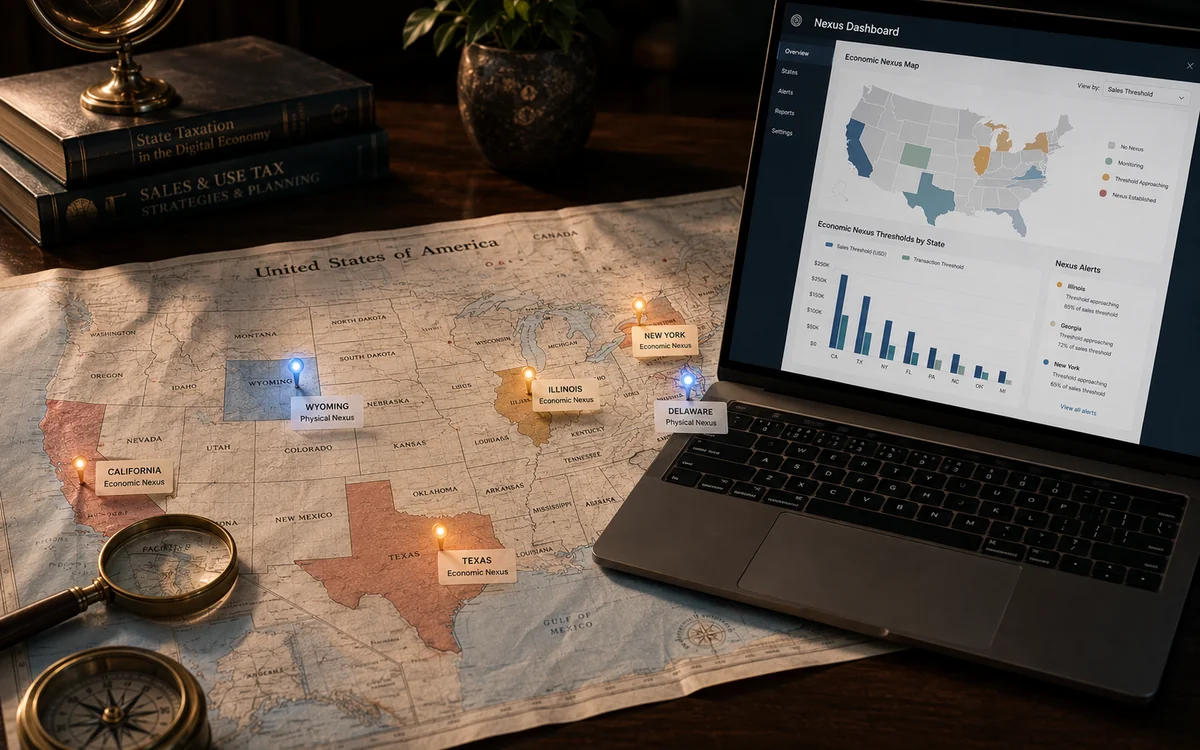
Before 2018: "no physical presence, no tax"
From 1992, after Quill v. North Dakota, the rule was simple: for a state to require Sales Tax collection, a business had to have "physical presence" in that state — office, warehouse, employee. If you were in Idaho selling into California online, with no warehouse or employees in California — California couldn't force you to collect Sales Tax. The buyer was formally supposed to pay "use tax" themselves. Almost nobody did.
This worked for 26 years.
Wayfair 2018: "economic connection is enough"
In 2018 the US Supreme Court in South Dakota v. Wayfair, Inc. flipped the rule. A state can now require Sales Tax collection from an out-of-state seller if there is "economic nexus" with that state — a defined volume of sales or transactions. Physical presence no longer required.
Short version: what matters now is your revenue volume in a specific state, not where your LLC sits.
What economic nexus is — and its thresholds
"Economic nexus" is the volume of sales or transactions above which you must register for Sales Tax in that state. Every state sets its own threshold.
Common patterns:
- Most states: $100,000 in sales per year. This is the Wayfair benchmark.
- Some states: $100,000 OR 200 transactions (e.g., New Jersey).
- Some states with higher thresholds: New York — $500,000 AND 100 transactions (both at once).
- Some states with lower thresholds: $10,000–50,000 per year.
- Some states with no transaction threshold: revenue dollar amount only.
The 2025–2026 trend: states are eliminating the transaction threshold (200 transactions) and keeping only the dollar threshold — as of May 2026, 16+ states have done so. This simplifies tracking: you only need to monitor dollar volume, not number of orders.
Recent 2026 changes: Illinois eliminated economic nexus on January 1, 2026; Kentucky eliminates on August 1, 2026.
Important: exact thresholds per state must be verified against current charts before registering — they change. Authoritative sources: salestaxinstitute.com, taxjar.com, avalara.com. Don't make financial decisions based on outdated specific thresholds.
Marketplace Facilitator Laws — what Amazon collects for you
Good news for most e-commerce sellers. All 50 states plus DC have, by 2026, passed "marketplace facilitator laws." The idea: if you sell through Amazon, eBay, Walmart, Etsy, or your Shopify via certain platforms — the marketplace itself collects Sales Tax from the buyer and remits to the state. You don't need to do anything for those sales.
Put differently: if 100% of your revenue runs through Amazon FBA — Amazon already handles Sales Tax. Your job is to not double-collect and to report correctly.
The complexity starts with mixed models:
- Part of revenue through Amazon (Amazon collects)
- Part through your own Shopify site (you collect)
- Direct B2B invoice sales (depends on state)
In a mixed model, each channel is counted separately. And the nexus threshold often includes all in-state sales, including through marketplaces — but the collection obligation splits between you and the marketplace. This is the nuance that confuses 80% of owners and needs case-by-case CPA review per state.
What to actually do as a non-resident e-commerce LLC
Step 1. Identify your model
- Amazon FBA only / Etsy only / eBay only? — Marketplace collects, you sleep easier.
- Own Shopify / WooCommerce + Stripe? — You collect, and must register in every state where you've crossed nexus.
- Mixed model? — Per-channel accounting required.
Step 2. Track revenue by state
The most important mechanical step. You can't know whether you've crossed nexus in Ohio without revenue breakdown by state. Automation services (TaxJar, Avalara, Anrok, Numeral) connect to Amazon/Shopify/Stripe and pull this breakdown automatically. Starting around $20–50 per month for small sellers.
Under $50K annual revenue — you can track manually in Google Sheets, pulling Amazon reports monthly. Above that — without automation it becomes a week-long task.
Step 3. Register in the state before the state writes to you
When you cross a threshold, you have a window (typically 30–90 days under state rules) to register. You register through the state's Department of Revenue website — you receive a Sales Tax Permit. Registration is free in almost every state.
After registration — you collect and remit on the state's schedule (typically monthly or quarterly).
Step 4. If you've already crossed and not paid
Most states have a Voluntary Disclosure Agreement (VDA) program — you voluntarily disclose you haven't paid, the state waives part of the penalty in exchange for back-tax payment usually for 3–4 years. Significantly cheaper than waiting for the state to find you (and with modern automation, states do find you).
Book a consultation with Edeal → book.edeal.ai
If you have e-commerce sales through Amazon/Shopify and want to figure out the nexus situation or set up automation, we have a dedicated team for it. More: US company formation and support.
Sales Tax vs Income Tax — don't confuse them
This deserves its own callout. Sales Tax and Income Tax are two separate systems.
- Sales Tax — a tax on the sale, collected from the buyer and remitted to the state. It's not your money at the moment of collection.
- Income Tax — a tax on the LLC's profit. This is about your money.
For a non-resident SMLLC owner, Income Tax is often absent or minimal (depending on the nature of the activity). But Sales Tax is an independent obligation that arises from selling into a state, regardless of whether you have an Income Tax obligation. More on Income Tax logic in the non-resident tax article.
Sales Tax for SaaS, digital goods, services
Separate complexity. Each state decides independently whether Sales Tax applies to:
- SaaS — about 20+ states tax it, the rest don't. The map shifts quickly.
- Digital goods (e-books, video, music) — taxable in most states.
- Professional services (consulting, development) — usually NOT taxable, with exceptions (Hawaii, New Mexico, South Dakota).
If you run a SaaS business selling nationwide — you need a tax advisor or automation service either way. Manual tracking isn't feasible.
Automation services
The top three:
- TaxJar (now part of Stripe) — most popular for small and mid-size sellers. Well-integrated with Stripe and Shopify. From $19/month.
- Avalara — enterprise solution, for larger players. More expensive, more powerful.
- Anrok — newer, SaaS-focused.
They automatically track nexus thresholds, calculate tax, register you in states, and file monthly/quarterly returns.
Quick checklist
- Identify sales model: marketplace / own site / mixed
- Marketplace only — Amazon/eBay collects for you; you monitor reporting
- Own site — set up revenue tracking by state (sheet or service)
- Verify against current state thresholds (taxjar.com or salestaxinstitute.com)
- Cross a threshold — register in the state within 30–60 days
- Already crossed and didn't pay — discuss VDA with a CPA
- Don't confuse Sales Tax and Income Tax — separate obligations
Untangle the nexus situation for your e-commerce?
At Edeal we help international e-commerce sellers handle Sales Tax: assess where you've already crossed nexus, register in states, set up automation, navigate VDA for late filings.
- Wayfair Economic Nexus FAQ — Sales Tax Institute
- Economic Nexus State Chart — Sales Tax Institute
- State-by-State Guide to Economic Nexus Laws — Avalara
- Economic Nexus Laws by State — TaxJar
Need help with US company taxes and reporting? Edeal handles your US tax compliance.