
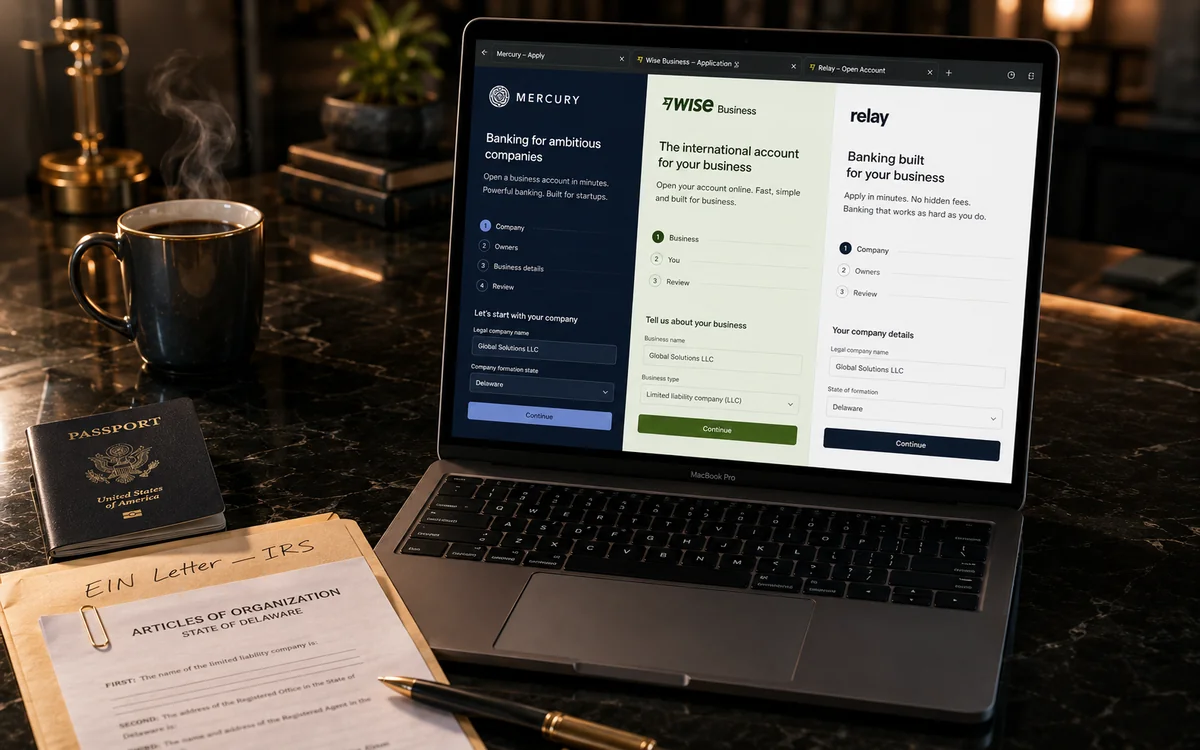
Wise and Payoneer Are a Starting Point, Not the Finish Line
Non-residents with a US company almost always start the same way: they need to receive dollars somehow, and they open a Wise Business or Payoneer account. A payment service activates remotely, in a couple of days, with no US trip and no long bank screening. It works on day one, and it works well.
The catch is that Wise and Payoneer are not banks. They are payment services. At the stage of "I need to receive my first client invoice" the distinction is invisible. At the stage of "the company has steady cash flow, multiple counterparties, contractor payouts and tax transfers" — the distinction becomes specific and measurable in dollars.
Where It Becomes Expensive
The non-obvious thing about payment services is the percentage-of-amount fee. On a small transfer it looks like $2–$5 and goes unnoticed. On a large transfer it scales linearly.
A concrete example from a real Wise transaction: the client sends 6,557 EUR, the company receives 7,200 USD. Wise fee: 358 EUR, roughly 5.47% of the sent amount. In dollars at that rate — about $416 of fee on a single transfer. Not for the year. For one.
If transfers of this size repeat monthly, you end up paying $5,000+ a year just on the cost of moving money. That is a budget line that nobody planned for, and the business often doesn't see it as a problem — until it adds it up.
In a US bank, the logic is inverted: an international wire costs a fixed amount, usually up to $35. Internal ACH transfers across the US are often free. The size of the transfer doesn't affect the cost.
So in one model, the cost of money movement grows with the business. In another, it doesn't. That's the moment when a payment service stops being convenience and becomes an expensive habit.
What Else Wise and Payoneer Don't Cover
Beyond the fees, there are structural limits that look technical on day one and become a real problem at scale.
Deposit protection. Funds in a US bank account are FDIC-insured up to $250,000 per account. Payment services are not banks; their funds are protected differently — through segregated accounts at partner banks. In practice it works, but in case of trouble at the payment provider itself, the recovery process for clients is longer and not guaranteed within the same window as FDIC. When you have $5,000 on the account, it's an abstract distinction. When you have $200,000, it's not.
Integrations. Stripe, PayPal, marketplaces, and enterprise counterparties in the US expect routing numbers and account numbers from real US banks. Wise and Payoneer provide their own aliases, which work in many cases, but not everywhere. Some crowdfunding platforms, ad networks, and B2B services will refuse to connect a payment service as the primary account.
Limits and compliance. As turnover grows, the payment service introduces additional reviews. An account can be frozen for 7–14 days while a review completes. For a business with regular outgoing payments — contractor invoices, tax payments — this is bad. Time-sensitive obligations get missed.
Business credit history. You can't build it through a payment service. You need a real US bank for a business credit card, supplier credit lines, lease terms. It's not critical in year one, but it becomes a ceiling in years two and three.
When a Payment Service Actually Makes Sense
Honestly: you don't always need to open a bank account immediately. There are situations where Wise or Payoneer is a working solution and remains so for a long time.
- You are a freelancer without a US company, receiving irregular small payments and spending them on living costs.
- You need a one-time international conversion or a transfer in an uncommon currency.
- The company was just registered, EIN received, but there is no operational activity yet — a payment service covers the first 2–3 months while the business reaches stable cash flow.
- A US bank account isn't available yet for your company structure or specific business model.
The key word is temporarily. Wise and Payoneer are good at covering the zero point — the moment when the company is just starting. They were not designed to be the permanent financial infrastructure of a working business.
What Changes With a Real US Bank Account
A full US bank account isn't "the same thing, just more expensive". It's a different infrastructure category.
You get ACH transfers (fast and often free within the US), proper wire transfers at a fixed fee, a debit card in the company's name, access to merchant services for card payments, a business credit card with a real credit limit, and — most importantly — the company starts existing in the US financial system. This changes vendor approval speed, the way major clients perceive you, and your ability to connect to enterprise services.
In parallel — some tax questions get easier. Money flows through an account tied to the EIN, and it's much cleaner to document during tax season than a payment service with hybrid reporting.
What We Do at Edeal for C-Corps
Opening a US bank account for a non-resident is a task that banks approach more strictly in 2026 than they did three years ago. But for the right company structure, it's still solvable remotely, without a US trip, in a reasonable timeframe.
At Edeal we have several proven remote bank account opening pathways specifically for C-Corps. Our team handles these openings regularly — we prepare the document package, format the business description so it passes bank compliance, walk through KYC, and follow through to account activation.
This isn't a single "bank we route everyone through". We have several options, and we match each client to the path that fits their business model, expected volume, transaction profile, and country of residence. The specific recommendation is made during the consultation.
If your company is currently an LLC and you're thinking about moving to a real bank — start with a conversation. In some cases it makes sense to convert to a C-Corp before opening the account; in others, it's better to keep using Wise/Payoneer a bit longer and open the bank account later. And if there's no company yet, we handle turnkey US company registration for you and take the account from there.
Open a US bank account for a C-Corp remotely? → book a consultation
On the call we review your company structure, business type, and recommend the right path — which of our account openings fits your case. More: US company formation and support.
Account Selection Checklist
If you are comparing options yourself, check:
- can the account be opened remotely, without flying to the US;
- does the bank or payment service work with your company structure (LLC, C-Corp, S-Corp) and your country of residence;
- what documents are required for KYC, and in what format;
- are there fees on incoming and outgoing transfers, and what kind;
- are international wire fees fixed, or a percentage of the amount;
- how does the bank behave as volume grows — hidden limits, additional reviews;
- is the account compatible with Stripe, PayPal, marketplaces, contractor payouts, and tax payments;
- is FDIC insurance in place, and who actually services the account.
This is the same checklist we walk through with each client on the consultation.
Bottom Line
A payment service is a tool, not a financial infrastructure. Wise and Payoneer do a good job covering the first months of a new company, but they shouldn't become the permanent money movement system.
If your company is a C-Corp, and turnover has moved past "irregular small payments," it's time to consider a full US bank account. Opening one remotely in 2026 is possible — with the right document preparation and the right solution selected for your business model.
Open a US business bank account remotely for a C-Corp?
At Edeal we have several proven pathways for remote US bank account opening for C-Corps — without travel, in standard timeframes. On the consultation we walk through your company structure and match you to the right option.