
The company exists, the tools don't
A familiar picture. Someone forms a US LLC, gets an EIN, makes it as far as a bank account — and hits a wall on the next step. They want a proper corporate card, spend management, cashback. What they get back is either silence or a request to confirm something a non-resident rarely has on hand.
I see it regularly. The company as a legal shell is already built. But the financial layer around it — cards, limits, expense tracking — often stays half-empty for a foreign owner. Not because the person did anything wrong. Most US fintech services are simply built by default for a resident with an SSN and a local credit history.
So you get a lopsided setup. The obligations show up immediately — reporting, taxes, deadlines. And the extra capabilities, which are part of why people open a US company in the first place, have to be chased down separately.
One card for everything is a weak idea
The most common setup in a small team: one corporate card that pays for absolutely everything. Meta ads, a couple of SaaS subscriptions, a purchase, a small thing for an employee. All on one card — and at the end of the month, a guessing game about where half the charges came from.
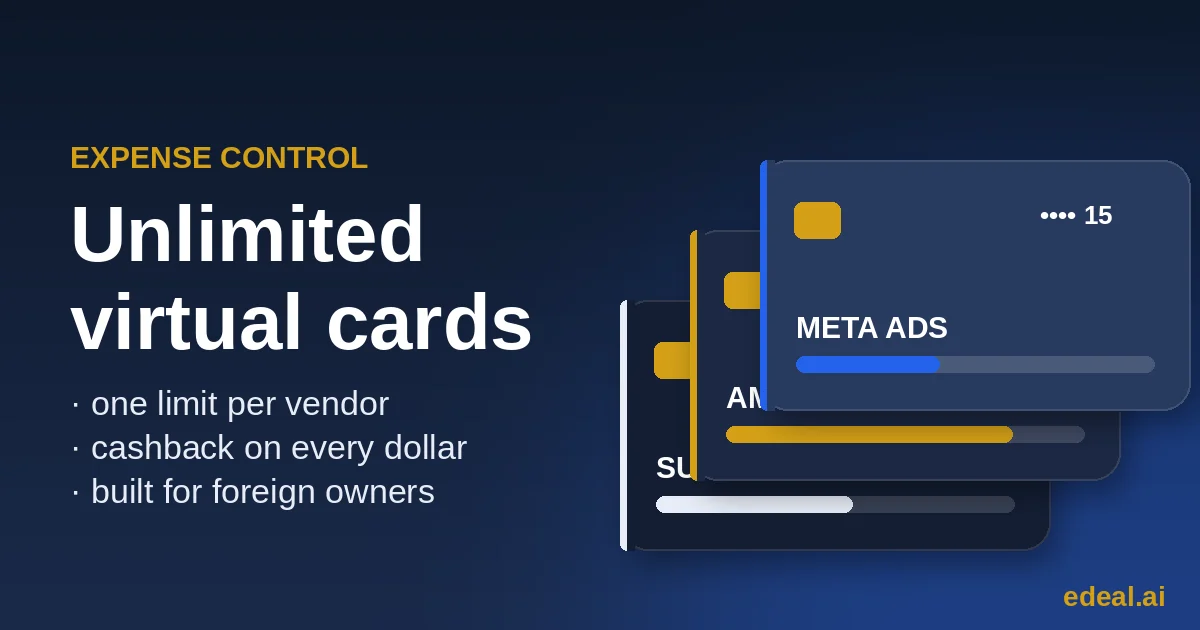
The service we recently started working with is built differently. It issues an unlimited number of virtual cards. A separate card for Meta, one for Google, one for Amazon, one per subscription, one per employee. Each with its own limit that you can change or zero out at any moment.
The difference shows up in the first month, not in theory. A subscription suddenly charges more — you see instantly which card. A contractor wraps up — you freeze that card in one move without touching the rest. This isn't a "nice feature." It's the point where company spending stops being a black box.
Cashback that stops being symbolic
Then there's cashback. Around one and a half percent on card transactions (the exact rate is set by the provider, per company). At first glance it's small. But if a business regularly pays for ads, SaaS, procurement and operations, one and a half percent adds up to more than coffee money.
Amazon sellers are the clearest case. When a company pours budget into Amazon ads month after month, card turnover is large. And a one-and-a-half-percent return on those amounts turns into thousands of dollars a year. Money that used to just leave now partly comes back. Not a promo, not a one-off bonus — a mechanic that works on every dollar of turnover.
We wrote about Amazon FBA and seller economics separately — cashback on ad budgets fits exactly the same logic.
Where it usually breaks
The third thing people underrate is expense management. Every company expense, employee cards, limits, receipts and supporting documents in one place. Not scattered across emails, not in three different spreadsheets, not "somewhere in the accountant's inbox."
For bookkeeping that's a relief on its own. When it's time to close the period, you don't chase receipts by person and try to recall what a payment was for. It's already tied to the card and to the expense. In my experience, this stage — collecting and reconciling — is exactly where small companies lose the most time and nerves.
What it looks like in real life
Last week we worked through a case with a client — a small team selling a physical product in the US market, owner living in Europe. Company in place, account in place, and expenses a mess. Ads, contractors, subscriptions, purchases: all on one card, and every month a couple of hours went to figuring out what any of it was.
We didn't do anything heroic. We split spending across separate virtual cards, set limits, wired up the tracking. A month later the owner sent one line I remember: "First time I can see where the money goes without sitting down to count." That feeling is the whole reason to hunt for these tools.
Worth being clear about what we don't do. We don't promise a "scheme" and we don't sell workarounds. A US company and normal financial tools are about transparency, not about hiding something. For an owner from a post-Soviet country, already under extra scrutiny, a clean and legible structure is worth more than any clever trick. Which is the same logic to keep in mind when you think about the state and entity choice.
Who this actually helps
Not everyone. If a company spends a couple of hundred dollars a month on one hosting bill, it doesn't need this whole garden of cards and limits — a debit card on the account is fine. The tool starts paying off where expenses are many and varied.
From my practice, three types of business get the most out of it. First, e-commerce and Amazon sellers: large ad budgets, purchases, returns, and meaningful cashback on turnover. Second, agencies and teams running other people's ads: a card per client kills the eternal "whose expense is this." Third, SaaS-heavy businesses and startups with a dozen subscriptions, where a card per service removes renewal surprises.
The common denominator is simple: several expense lines, several people with access to company money, and a wish to see the picture instead of assembling it by hand at month end.
Where this even starts
None of it — cards, cashback, tracking — appears in a vacuum. Underneath sits a US company with an EIN and a working business account. That's the foundation, and the order doesn't rearrange: company and account first, the layer on top after.
So we look at it as one structure, not a set of separate services. When a client starts from scratch, we open the LLC and EIN, help with a business account, and only then plug in cards and spend management. When the company already exists, we start at the step where the person got stuck.
Why it surfaces at filing time
There's one more side people miss while choosing a card. A US company with a foreign owner has obligations to the IRS — the same Form 5472 for a foreign-owned LLC that few people look forward to. And when it comes to preparing that filing, tidy expense records collected across the year save a lot of time and remove half the questions.
I see this from both sides — as an EA and as the person who later assembles those filings. A company where expenses sit sorted by card and backed by documents closes the period calmly. A company where everything was paid off one card "however it happened" spends March heroically reconstructing history from a bank statement. The difference isn't the owner's discipline — it's whether the tool let them sort things into place from the start.
Want to build the financial layer around your company? → book a consultation
On the call we'll walk through your situation: bank account, cards, limits, expense tracking, and which tools will realistically open under your structure. You can't run cards without a working US business account — that's where we start.
Why I'm writing about a specific service at all
I usually don't cover individual products. But here there's a reason worth the exception.
The service is called Ramp. And the key thing about it for our audience isn't the cards or the cashback on their own — it's that you can open it on a US company with foreign owners. We've already been through this registration with owners from Russia and Ukraine living in Europe and Asia, and with owners on European residence permits. Those applications carry their own nuances, extra checks and document requests. But it's a working option, not a theory.
For a foreign owner that's rare. Usually these tools come with "available for companies with resident owners," and you close the tab. Here it's different.
The part nobody spells out
Now the honest part. I don't recommend just going to the site and filling in the application yourself. In our experience, in about nine cases out of ten, foreign owners hit extra questions, document requests or snags during registration. And the person gets stuck not because they made a mistake, but because they didn't know how to present the data more cleanly.
Here's what it looks like in practice: they may re-ask about the company address, ask you to describe clearly what the business does, or clarify the source of funds on the account. Nothing scary in those questions — but for someone seeing them for the first time and answering in a second language, each request easily turns into a week-long pause. Sometimes into a rejection, after which re-applying is harder.
There's a money threshold too. As standard, the service wants to see roughly $25,000 on the company's accounts. When the application goes through Edeal, our clients qualify from $10,000. That's a real difference, especially early on.
So the logic is simple. Better to message our manager or book a consultation first — we'll share the partner link, tell you how best to present the data, and if a problem or extra request comes up along the way, we'll step in and help with the communication. For the client, our help is free.
I'm deliberately not laying out a step-by-step "how to apply" here. Not to be difficult. It's just the kind of case where a couple of details in the wrong order cost a week of waiting and a rejection — and I'd rather it went through someone who has seen these applications before.
Want to open Ramp on your non-resident company?
Message us before you apply. We'll share the partner link, help prepare the data and cover you on the checks. No company yet? We'll open the LLC and EIN, then build cards, an account and expense tracking around it.
These are exactly the tools we try to find for Edeal clients. So that a US company gives back more than obligations and reporting — control, part of your spending returned, less manual work. The obligations reach a company owner on their own. The capabilities almost always have to be sought out separately — and it's good when they aren't far to reach.