
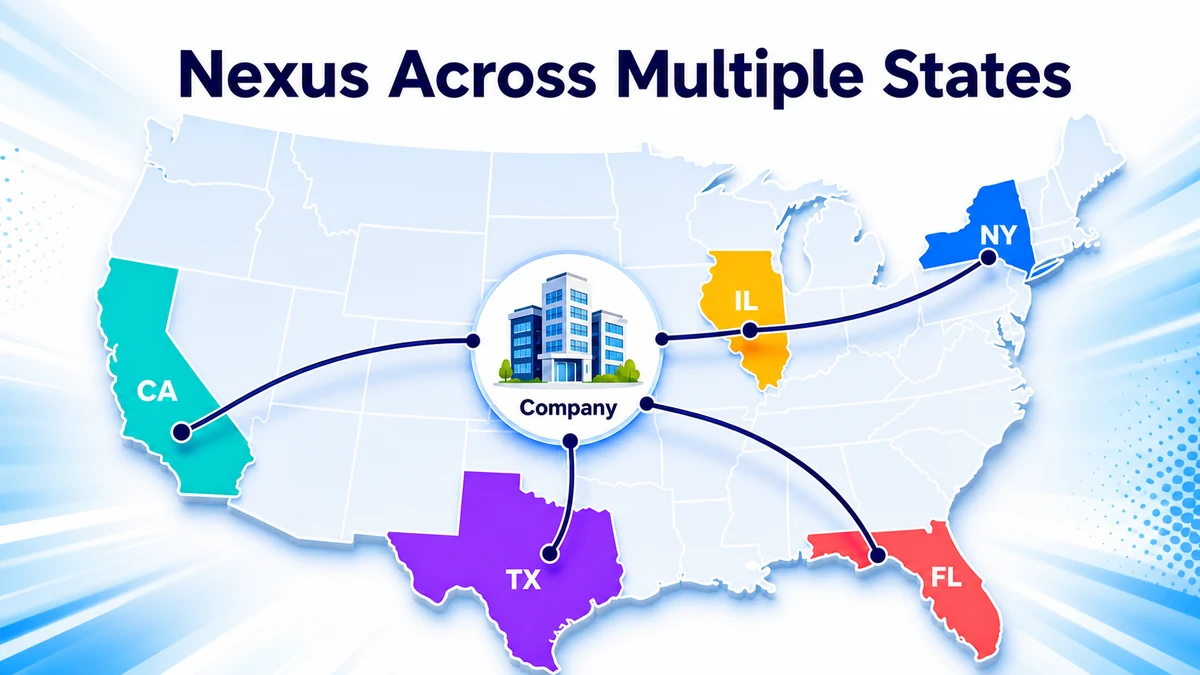
What nexus is, in plain terms
Nexus is a sufficient connection between your company and a state that gives the state the right to require something of you: to tax you, or to make you collect and remit a tax. The word itself roughly means "a link" or "a tie." And the whole point is that this connection arises not when you formally "enter" a state, but when the state considers that you are present there enough.
The key trap is this. Many founders think in terms of "where I registered my company." States think in terms of "where you actually act." A company can be formed in Wyoming yet have a tax connection in California, New York, and a couple of other states — simply because there's an employee, inventory, or significant sales there. Registration and presence are two different maps, and they rarely line up perfectly.
Three different kinds of nexus everyone confuses
The first thing to get straight: "nexus" is not one threshold or one form. There are at least three kinds of connection, and they trigger independently of each other. You can avoid one and easily fall under another.
1. Sales tax nexus
Until 2018 the rule was simple: no physical presence, no obligation to collect sales tax. In 2018 the US Supreme Court, in South Dakota v. Wayfair, scrapped that rule. Now economic presence is enough: if your sales into a state exceed a threshold, you must register and collect tax there — with no office and no warehouse.
Many states took $100,000 in sales or 200 separate transactions a year as the baseline. But that's just a baseline: some states set the bar at $500,000, some dropped the transaction count, and they all measure the period differently. The specific numbers for a specific state change and must be checked separately.
2. Income tax and franchise tax nexus
This is a separate connection — don't confuse it with the previous one. For income and franchise taxes, states have their own standards. Many use so-called factor-presence: the connection arises if your property, payroll, or sales in the state exceed a set level (in the model standard, on the order of tens of thousands of dollars for property and payroll and hundreds of thousands for sales, or more than a quarter of your total activity).
A crucial nuance: these thresholds often do not work as protection. Being below a threshold doesn't mean you're safe — a state can find "doing business" on other grounds, such as physical presence. The tax authorities themselves say so directly.
3. Physical-presence nexus
This is the oldest and most underrated kind. It's created by very ordinary things: an office or a store, an employee (including a remote one living in the state), property, and also inventory in a warehouse — including inventory in an Amazon warehouse that Amazon sent there on its own algorithm. A contractor or agent in the state can create it too.
Physical presence produces the most surprising triggers. You don't always control where your goods end up or where your person works from — yet the connection arises anyway.
Nexus is not the same as foreign qualification
This is where founders get confused most, so let me spell it out. There are two different worlds.
Nexus is a tax concept. It's handled by the state's revenue department and is about the state's right to your tax.
Foreign qualification is a registration concept. It's the process of officially registering a company from one state as "foreign" in another state through the Secretary of State, so you can legally operate there. The output is a certificate (Certificate of Authority) and an obligation to keep a registered agent in that state.
These obligations often go together — the same presence can trigger both a tax connection and a duty to register. But they're different agencies and different grounds. You can have tax nexus without being registered, or be registered without owing a given tax. So you have to look at both sides at once.
How nexus affects your choice of state
From this comes the main practical takeaway: choosing your state of registration and the question "where will I owe taxes" are not the same thing.
The classic illusion is "I'll register in Delaware and only pay there." Forming in Delaware does not by itself create nexus in other states: Delaware is a choice of corporate law and structure, not a tax haven. If you actually work out of California or keep inventory in Florida, the tax connection arises there. I unpacked this myth in the article on Delaware: when it's worth it and when it's not.
Same with Wyoming and Nevada. They have no state income tax, and that's genuinely convenient. But "no income tax of their own" doesn't mean "no taxes at all": you still pay annual fees to the state of registration and create obligations wherever you physically or economically operate. A Wyoming company with an employee in New York is New York nexus, not Wyoming nexus.
What different states say
Every state has its own logic and its own character. Below is the general picture for key states. Exact figures and wording change, so treat the table as a reference point, not a ready-made answer for your situation.
| State | How it views presence | What to know |
|---|---|---|
| California | The broadest "doing business" approach. Treats even inventory in a warehouse and minor activity as presence. | Minimum annual fee of $800 for an LLC registered or doing business in the state, even at zero revenue. |
| Texas | Franchise (margin) tax with an economic threshold on in-state revenue, no physical presence required. | Threshold higher than California's; watch your sales volume into Texas. |
| New York | Corporate tax with an economic threshold on NY-sourced revenue; a separate annual fee for LLCs. | The threshold is periodically indexed — check the current figure. |
| Washington | B&O tax and sales tax with an economic threshold on in-state revenue. | No income tax, but there is a gross-receipts tax — easy to miss. |
| Delaware | Does not by itself create nexus in other states. Popular for its corporate law. | Has its own annual franchise fee for companies formed in Delaware. |
| Wyoming / Nevada | No state income tax, but there are annual fees and a mandatory registered agent. | Nexus arises where you actually work, not in the state of registration. |
Not sure which states you already have presence in? → let's map it on a consultation
We'll look at your structure, sales channels, and where your people and inventory physically sit — and tell you honestly where a connection already exists and where it doesn't yet.
Real cases: how states recognize presence
The theory clicks with examples. Below are documented stories that show how differently states read "presence."
Swart Enterprises v. California: a 0.2% stake and a tax bill
An Iowa company owned a 0.2% passive interest in a California investment fund (an LLC) — no management rights, no employees or office in the state. California's tax authority (the FTB) nonetheless billed it the $800 minimum fee as "doing business" in the state. The case reached the Court of Appeal, and in 2017 the court sided with the company: passively holding a tiny interest is not "doing business." California lost.
This case matters for two reasons. It shows how far a state will reach for money — and, at the same time, that this reach has a limit that can sometimes be defended in court.
Diet Standards: inventory in an Amazon warehouse — and California wins
Now the opposite outcome. An LLC formed in Delaware and operating out of Florida sold via Amazon FBA. Amazon placed some of its inventory in California warehouses. In 2025 California's Office of Tax Appeals (OTA) ruled: inventory in a warehouse is physical presence, and therefore "doing business," regardless of the fact that sales were below the thresholds. The minimum fee was assessed. Separately, it was confirmed the same rule applies to corporations, not just LLCs.
Here is that surprising trigger: you don't decide where Amazon lays out your goods — yet the tax connection arises anyway.
Pennsylvania: same facts, different result
To show there's no single nationwide rule: in 2022 Pennsylvania tried to assert nexus on third-party sellers on exactly the same basis — Amazon inventory in the state's warehouses. And it lost in court: the judges held that a seller doesn't control where Amazon moves its inventory. So on identical facts California wins and Pennsylvania doesn't. That's the core difficulty of the topic: the answer depends on the state.
Metro Mortgage: a $121 payment
Another example from tax lawyers' write-ups: in one California case, a connection was found because of a $121 payment to someone working for an out-of-state company. A laughably small sum — with a very real consequence. It's a good illustration that the "materiality" bar can be very low in practice.
A single remote employee
This isn't a separate case but a universal rule every advisor confirms: one employee working from a state usually creates presence immediately — for income tax, payroll taxes, and the duty to register. For our clients this is the most common hidden nexus: they hire someone "remotely" and effectively open the company's presence in that person's state.
Our case: the letter that surfaced a presence
From our practice at edeal.ai. A client came to us with a company registered outside California — and a demand from the California tax authority. The trigger was a letter that arrived at a California address tied to the company. Technically the tax isn't created by an envelope but by the presence behind it: an in-state address showed the tax authority that the activity was, one way or another, connected to California — and it started unwinding the connection from there. To the owner it looked like "a letter arrived and suddenly I owe the state," when in reality the letter just brought to the surface what already existed.
The lesson I take from stories like this: a state doesn't need your loud market entry to notice you. Sometimes one address, one person, or one shipment to a warehouse is enough.
What lawyers say about it
The topic has long been on US tax practitioners' radar, and their wording is telling.
"These cases demonstrate that even taxpayers who themselves have no direct activities in a jurisdiction may find themselves within reach of that jurisdiction's taxing authority. States like California may continue to test the limits of their tax reach on out-of-state companies."Carley Roberts, SALT partner, Pillsbury Winthrop Shaw Pittman
One telling fact: in a filing to the US Supreme Court, the State of Arizona explicitly called California's approach to asserting presence "aggressive" — so even another state, not just taxpayers, complains about the overreach.
Tax advisers (for example, specialists at the firm HCVT, who analyzed the recent California decisions) separately stress that economic thresholds should not be treated as a protective barrier. In practice they work not as "below the threshold, you're free" but as an additional test: you can be below the numbers and still have a filing obligation because of physical presence.
And tax-policy researchers (the Tax Foundation) point to a broader problem: after Wayfair, the patchwork of rules across states put a disproportionate burden on small and mid-sized businesses — compliance is expensive, and everyone's rules are different.
What happens with presence in multiple states
Now the main question this was all leading to. Suppose presence arose not in one state but in three. What changes in practice?
Foreign qualification in each such state. Wherever you "do business," the company has to be registered as foreign. That means a separate registered agent, a separate annual report, and separate fees — each state its own. Three states of presence is, roughly, a triple set of routine.
Income apportionment across states. When a business operates in several states, income is split between them by a formula. States use different formulas (some count only sales, some also property and payroll), plus separate rules like throwback. The upshot is simple: the more states, the more complex and usually more expensive the calculation.
Penalties for operating without registration. If you do business in a state and don't register, the consequences can be tangible. Back taxes with interest are possible. One especially unpleasant detail: in many states an unregistered company cannot bring lawsuits in local courts until it cleans up its registration. So others can sue you, but you can't defend your interests through the court. Exact penalties depend on the state, and this is precisely where the numbers are better checked case by case.
On sales tax specifically: as soon as economic or physical presence arises, so does the obligation to register and collect sales tax. I covered that side in detail in the article on Sales Tax for e-commerce LLCs.
How to avoid creating nexus by accident
You can't fully avoid nexus if you're genuinely growing — and you don't need to. The goal isn't to hide from states but to make sure the connection doesn't arise unnoticed and in places you didn't plan for. A few practical guideposts.
Know where your people and inventory physically are. A remote employee in a new state and a batch of goods in a new warehouse are the two most common "quiet" triggers. Before you hire someone or ship goods, understand that you are likely opening a presence in their state.
Separate your state of registration from your state of operations deliberately. Forming in Wyoming doesn't cancel obligations where you actually work. That's fine — it just should be your decision, not a surprise a year later.
Check before, not after. It's cheaper to find out you're about to create a connection before you act than to untangle a back assessment later. This is especially true for FBA: you don't control Amazon's warehouses, so presence can spread across states on its own.
How we approach this at Edeal
My position is simple: a founder shouldn't run a company blind. Nexus is dangerous not because it's complicated but because it's invisible — the connection builds up quietly and surfaces as a letter from the state a year or two later.
So we start with the real map: where the people physically are, where the inventory sits, where sales come from and through which channels. From that it's clear where presence already exists, where it's about to, and where you can deliberately avoid creating it. That's far cheaper and calmer than untangling assessments after the fact. You can quickly gauge your company's standing with our free diagnostic.
Frequently asked questions
What is nexus in plain terms?
A sufficient connection between your business and a state that gives the state the right to tax the company or require it to collect tax. The connection can be physical (office, employee, inventory) or economic (sales volume).
How is nexus different from foreign qualification?
Nexus is about tax (the revenue department). Foreign qualification is about registering the company as foreign with the Secretary of State. Different obligations, often arising together.
Does forming in Delaware create nexus elsewhere?
By itself, no. The connection arises where you actually operate: people, inventory, an office, significant sales.
Can inventory in an Amazon warehouse create nexus?
Yes, in many states inventory in a warehouse counts as physical presence — even if sales are below thresholds. Practice varies by state.
What happens if you operate in a state without registering?
Back taxes with interest are possible, and in many states you lose the right to bring lawsuits in that state's courts until you register. Exact consequences depend on the state.
Bottom line
Nexus is about where a state sees you, not about where you formed your company. There are three independent kinds of connection (sales tax; income/franchise tax; physical presence), and any one of them can trigger on its own. Registering in a "convenient" state doesn't cancel obligations where you actually work. And presence in several states at once means multiplied routine: registrations, agents, reports, and income apportionment.
The good news is that this is manageable if you see the map in advance. If you want to understand which states your company already has presence in and what to do about it, come to a consultation and we'll look at your specific structure.
Find out which states you have nexus in
On a consultation we'll review your structure, sales channels, and where your people and inventory are — and build a map: where presence already exists, where it's coming, and what to do next. Calmly and based on facts.
Sources
- US Supreme Court decision South Dakota v. Wayfair, Inc. (2018) — end of the physical-presence rule for sales tax: law.cornell.edu
- Swart Enterprises, Inc. v. Franchise Tax Board (California Court of Appeal, 2017): law.justia.com
- Appeal of Diet Standards, LLC (California Office of Tax Appeals, 2025) — Amazon warehouse inventory as "doing business": ota.ca.gov
- Online Merchants Guild v. Hassell (Pennsylvania Commonwealth Court, 2022) — refusal to find nexus based on warehouse inventory: pacourts.us
- Analysis of California OTA practice (Diet Standards, Fishbone Apparel, Metro Mortgage — a $121 payment), HCVT: hcvt.com
- Pillsbury commentary (Carley Roberts) and Arizona's position on California's "aggressive" tax policy: pillsburylaw.com
- State Online Sales Taxes in the Post-Wayfair Era — on the burden on small business, Tax Foundation: taxfoundation.org
- Edeal's practice supporting clients with companies operating in multiple states.
Need help with US company taxes and reporting? Edeal handles your US tax compliance.