
Why November, not March
A business tax return is the result of the year, not a separate project. If the books were kept properly all year, a tax professional only has to review the numbers, apply the tax rules and file. If not, they first rebuild the picture from bank statements — and that always takes longer and costs more.
There is a harder reason too: January. Forms 1099 for 2026 payments go to contractors and the IRS in early 2027, well before the return itself is due. That requires W-9s, which you collect in advance. A contractor you stopped paying in August may simply not answer your email in January.
It helps to split year-end prep into three blocks:
- Documents from the people you pay — W-9s from US contractors, W-8BENs from foreign ones.
- Information returns — the 1099-NEC and 1099-MISC you issue, plus the 1099-K and 1099-NEC forms you receive.
- Income and expense records — a closed year, reconciled to the bank, with supporting documents.
We put the full 2027 tax calendar in a separate deadline guide on our Telegram channel. Below is what to prepare for each of those dates.
Form W-9: collect it before the first payment, not in January
Form W-9 is how a US payee gives you their name, tax classification and Taxpayer Identification Number (an SSN or EIN). The IRS describes its purpose simply: you use it to provide your correct TIN to the person who is required to file an information return with the IRS. You don't send it to the IRS — you keep it on file.
A W-9 gives you three things you need for a 1099:
- The exact name and TIN. A wrong number is a common reason for IRS name/TIN mismatch notices.
- The tax classification. Individual, LLC, partnership, C or S corporation. This decides whether a 1099 is needed at all (exceptions below).
- The mailing address for the recipient's copy.
The current revision is Form W-9 (Rev. March 2024). Older forms already on file are fine, but use the current one for new contractors.
A rule that saves a lot of stress: don't pay a new US contractor until you have a signed W-9. Chasing forms in January from people you've already paid in full is much harder.
What if a contractor doesn't give you a W-9
If a payee fails to provide a TIN, or provides an incorrect one, the IRS requires the payer to apply backup withholding — 24% of the payment — and send it to the IRS. This covers payments to independent contractors reported on Form 1099-NEC. Backup withholding is reported annually on Form 945, and in that case a 1099-NEC is required regardless of the amount paid.
In practice, without a W-9 you either withhold 24% and take on extra reporting, or you risk the IRS holding you liable for the tax you should have withheld.
What if the contractor is outside the US
A foreign contractor doesn't fill out a W-9. They certify their status on Form W-8BEN (individuals) or W-8BEN-E (entities). If they do the work outside the United States, no 1099 is filed. We cover when you need which form, and when Form 1042-S comes into play, in How to pay contractors and freelancers from a US LLC.
Forms 1099-NEC and 1099-MISC: the new $2,000 threshold
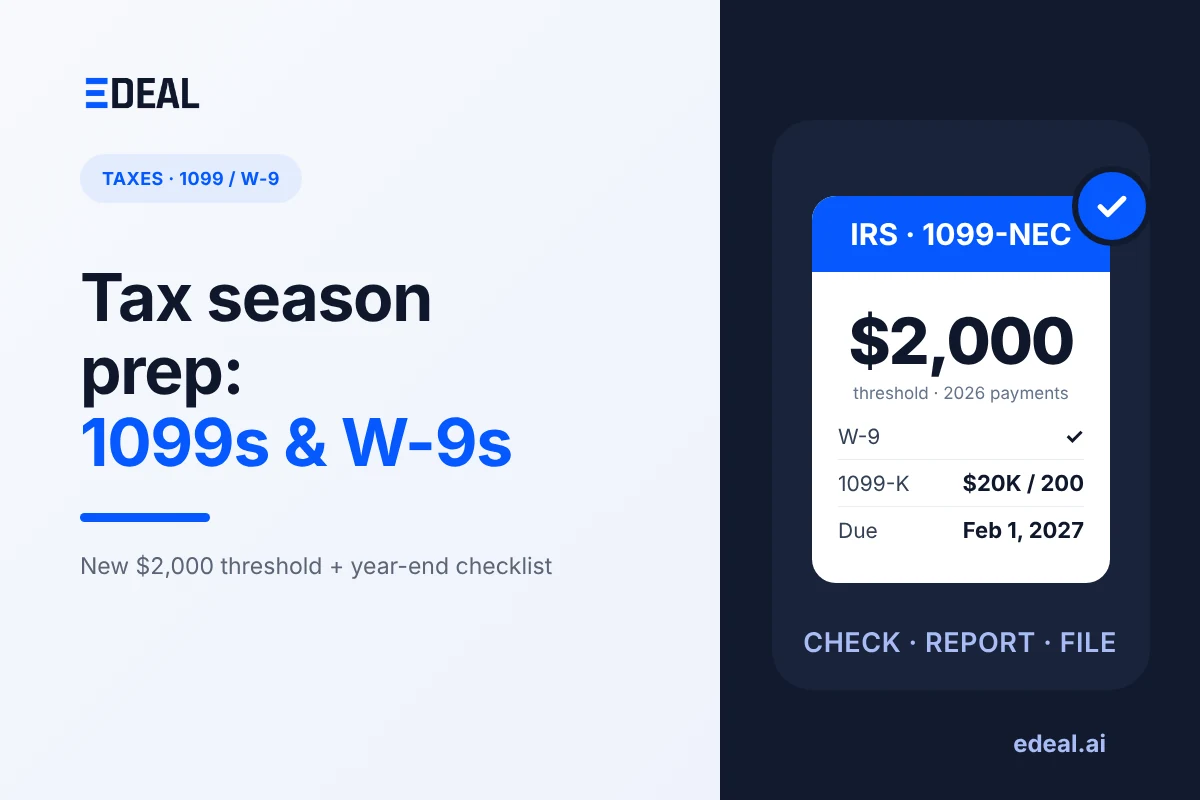
This is the main change of the year. The One Big Beautiful Bill Act (P.L. 119-21) raised the reporting threshold. The IRS instructions for Forms 1099-MISC and 1099-NEC say that for tax years beginning after 2025, the minimum threshold increased to $2,000 and may be adjusted for inflation starting in 2027.
Here is what that means for 2026 payments, which you report in early 2027:
| Form | What it reports | Annual threshold per payee |
|---|---|---|
| 1099-NEC, box 1a | Payments for services to non-employees: contractors, freelancers, consultants | $2,000 (was $600) |
| 1099-NEC, box 1a | Attorneys' fees paid to lawyers and law firms | $2,000 |
| 1099-MISC, box 1 | Rents: office, warehouse, equipment | $2,000 (was $600) |
| 1099-MISC, box 10 | Gross proceeds paid to an attorney (for example, in a settlement) | $600 — unchanged |
| 1099-NEC | Any payment subject to backup withholding | Any amount |
Don't mix up the years. The $2,000 threshold applies to payments made in 2026. Forms for 2025, filed in early 2026, still used the old $600 threshold. If you have unfiled or corrected 2025 forms, $600 applies to them.
Who doesn't get a 1099
The IRS instructions include several exceptions that are easy to forget:
- Corporations. Payments to corporations, including LLCs taxed as C or S corporations, generally aren't reported on a 1099. You'll see the classification on the W-9.
- Except lawyers. The corporate exception doesn't apply to payments for legal services. A law firm organized as a corporation still gets a 1099-NEC.
- Card and payment-app payments. The IRS is explicit: payments made with a credit card or payment card, and third-party network transactions, are reported on Form 1099-K, not on Form 1099-MISC or 1099-NEC. If you paid a contractor by card or through PayPal (Goods & Services) or a similar service, the payment processor reports that part, not you.
- Foreign contractors working outside the US, as described above.
- Personal payments. A 1099 is only required for payments made in the course of your trade or business.
Deadlines and how to file
Form 1099-NEC goes to the recipient and to the IRS by January 31. In 2027, January 31 falls on a Sunday, so the deadline moves to Monday, February 1, 2027. An extension on Form 8809 for the 1099-NEC is granted only in limited cases, which makes this one of the strictest deadlines of the year.
Form 1099-MISC goes to the recipient by January 31. It's filed with the IRS by February 28 on paper (a Sunday in 2027, so March 1) or by March 31 electronically.
Since 2024, the ten-return rule applies: if your company files 10 or more information returns in total for the year (all 1099 types and W-2s count together), they must be filed electronically. The IRS offers a free system for this, IRIS; tax professionals and filing services use it or their own software.
Penalties for late or incorrect forms apply per form and grow with the delay. For information returns due in 2027, the IRS amounts are:
- $60 per form if corrected within 30 days of the due date;
- $130 if filed later but by August 1;
- $340 if filed after August 1 or not filed at all;
- $690 for intentional disregard, with no annual cap.
With ten contractors, even a short delay becomes real money.
Form 1099-K: what changed and why it isn't about tax
Form 1099-K is issued by payment processors and marketplaces: Stripe, PayPal, Amazon, Shopify Payments and others. It shows the gross amount of payments they processed to you during the year.
Congress reversed course here. The threshold was set to drop gradually to $600, but the One Big Beautiful Bill Act retroactively restored the earlier rule. In its guidance (IR-2025-107), the IRS says a payment settlement entity doesn't have to file a 1099-K unless gross payments to a payee exceed $20,000 and the number of transactions exceeds 200. Both conditions must be met.
That creates a common trap. A business owner sees no 1099-K and concludes the income "never reached the IRS." That's wrong. The 1099-K threshold is a rule for the payment processor, not for you. All business income is taxable whether or not a form was issued for it.
How to reconcile a 1099-K with your books
When a 1099-K does arrive, the amount almost never matches the revenue in your books. That's normal: the form shows gross receipts before refunds, processing fees and chargebacks, often including sales tax collected. Your job at year-end is to explain the difference:
- Start with the gross amount on the 1099-K.
- Subtract refunds and chargebacks — they reduce revenue.
- Record processor and marketplace fees as expenses.
- Remove sales tax collected and remitted, if it's included in the gross amount.
- Confirm the result matches revenue in your books for that channel.
If you sell on marketplaces in several states, see our article on sales tax for e-commerce LLCs.
Don't forget the other side. If your company provides services to US clients, it may receive 1099-NEC forms from them in January. Collect them and match them against revenue: the IRS compares these forms with your return automatically.
Not sure which contractors need a 1099, or how to reconcile revenue with your 1099-K? At tax.edeal.ai we help companies get ready for tax season and plan taxes before year-end, while there is still time to change the outcome.
Income and expense records: close the year before it ends
The return is built on the books. Even the best tax professional can't file a correct return from incorrect numbers. Here's what to do before year-end.
1. Separate personal and business
A dedicated business bank account and card are basic hygiene. If personal expenses went through the company or the other way around, find them and record them correctly: as an owner contribution, an owner draw or a loan. Commingled accounts are the main reason tax prep gets slow and expensive, and a weak spot in an audit.
2. Reconcile the books to the bank every month
Every transaction on every account and card should be in the books and categorized. The December 31 balance in your books should match the statement. Check payment processors and marketplaces separately: their balances are company money too.
3. Use categories the tax return understands
Advertising, contractors, software and subscriptions, rent, fees, travel, professional services. For product businesses, cost of goods sold and year-end inventory are tracked separately. Equipment above a certain cost is usually not expensed right away but recorded as a fixed asset; how to deduct it is decided when the return is prepared.
4. Total contractor payments by payee
This is your direct bridge to the 1099s. You need a table: contractor, whether you have a W-9 or W-8BEN, how much you paid for the year, and how (bank, card, PayPal). If bank transfers to a US contractor that isn't a corporation reached $2,000 or more, that's a 1099-NEC candidate.
5. Keep supporting documents
Invoices, contracts, receipts, statements. The IRS expects every deduction to be supported. Keep records until the period of limitations for the return runs out:
- 3 years — the general rule;
- 4 years — employment tax records, and copies of 1099s where backup withholding applied;
- 6 years — if you didn't report income that is more than 25% of the gross income shown on the return;
- 7 years — if you claimed a loss from worthless securities or a bad debt deduction;
- indefinitely — if no return was filed.
6. Check what you've already paid
Quarterly federal and state estimated payments, franchise taxes and annual fees all need to be accounted for, so you don't overpay or get an underpayment penalty. More in our article on quarterly estimated tax payments for LLCs.
Bookkeeping done for you by Edeal
Bank and card reconciliation, expense categories, contractor payment tracking, collecting W-9s and documents — everything described above is what we do for clients every month. If this feels like a lot, you're welcome to hand it to us — we'll take care of all of it. By tax season you'll have a closed year and your 1099s ready.
What depends on your entity type
Bookkeeping prep is similar for everyone, but which return you file and when depends on the tax classification.
| How the company is taxed | Return | Due date for calendar year 2026 |
|---|---|---|
| Single-member LLC owned by a US resident (disregarded) | Schedule C on the owner's Form 1040 | April 15, 2027 |
| Single-member LLC owned by a non-resident | Form 5472 with a pro forma 1120 | April 15, 2027 |
| Multi-member LLC (partnership) | 1065 + K-1s to members | March 15, 2027 |
| S corporation | 1120-S + K-1s | March 15, 2027 |
| C corporation | 1120 | April 15, 2027 |
Even with no income, a company usually still has to file. For a foreign-owned LLC this is critical: the penalty for a missing Form 5472 starts at $25,000. We covered this in our article on Form 5472 for foreign-owned LLCs.
Your November–December checklist
The short version of everything above:
- List every contractor and landlord you paid in 2026.
- Check who has a W-9 (US) and a W-8BEN / W-8BEN-E (foreign). Request the missing ones now.
- Total payments to each payee for the year and note how you paid.
- Decide who needs a 1099-NEC or 1099-MISC under the new $2,000 threshold.
- Reconcile bank accounts and cards with the books through November 30, then through December 31 in January.
- Find and reclassify personal transactions.
- Pull payment processor and marketplace reports to reconcile with upcoming 1099-Ks.
- Confirm estimated payments and state fees already paid.
- Before December 31, discuss tax planning: which decisions can still be made this year.
- Put February 1, 2027 — the 1099-NEC deadline — on your calendar.
FAQ
I paid a contractor $1,800 in 2026. Do I need a 1099-NEC?
Generally no: the threshold for 2026 payments is $2,000. The exception is backup withholding: if you withheld, the form is required regardless of the amount.
My payment processor didn't send a 1099-K. Can I leave that income off?
No. The $20,000 and 200-transaction threshold only decides whether the processor files a form. All of your company's income goes on the return either way.
Do I file a 1099 for a contractor I paid through PayPal or by card?
Card payments and third-party network transactions are reported by the processor on a 1099-K, not on your 1099-NEC. If you paid partly by bank transfer and partly through PayPal, only the bank transfers go on the 1099-NEC.
Do I file a 1099 for a contractor that is an LLC?
It depends on the LLC's tax classification on the W-9. An LLC taxed as a C or S corporation generally doesn't get a 1099-NEC, except for legal services. A single-member LLC or a partnership does.
How long should I keep expense records?
At least 3 years from the filing date, and 4, 6 or 7 years in some cases. The safe approach is to keep each year's documents electronically for at least 7 years.
The bottom line
A good tax return is the result of a closed year, not a marathon in March. Collect W-9s and W-8BENs, check contractor payments against the new $2,000 threshold, reconcile the bank and payment processors, and separate personal from business. Then the January 1099s and the spring return take days, not weeks.
And most importantly, before December 31 you still have time not just to prepare but to change how much tax you owe. After New Year's, all that's left is to calculate what already happened.
Want to go through this checklist with a professional and know your 2026 tax in advance? Request a review at tax.edeal.ai — we'll get your company ready for tax season and build a tax plan. Or book a consultation.
Sources
- IRS — Instructions for Forms 1099-MISC and 1099-NEC
- IRS — IR-2025-107: Form 1099-K threshold under the One, Big, Beautiful Bill
- IRS — General Instructions for Certain Information Returns
- IRS — Information return penalties
- IRS — Backup withholding; About Form W-9
- IRS — How long should I keep records
- IRS — E-file information returns with IRIS
Get your company ready for tax season
We'll review contractors and 1099s, reconcile your books and project your 2026 tax while there is still time to change it before December 31.