
The State of Your LLC and the State of Your Sales Tax Are Two Different Geographies
A founder launching an Amazon business typically forms a simple mental model: my LLC is in Wyoming (or Delaware, or New Mexico), so every tax registration must be in that same state. The logic feels intuitive — but it doesn't work for Online Arbitrage and Wholesale.
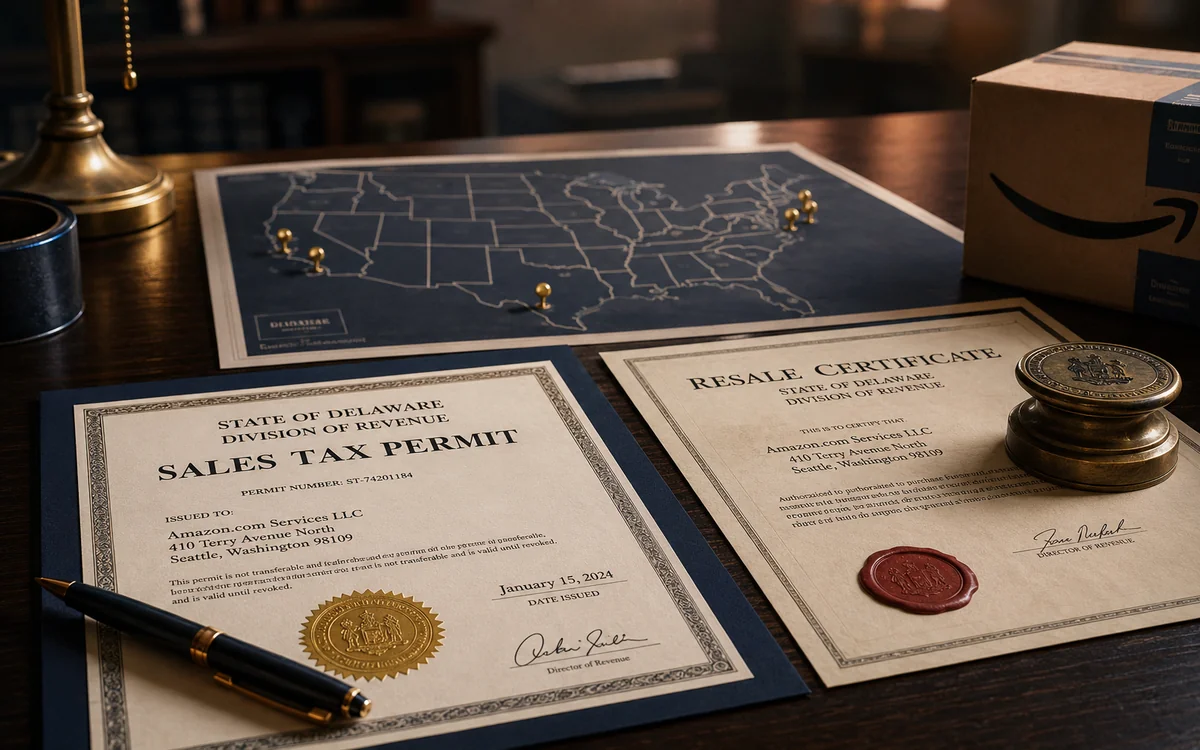
Sales Tax is a state retail tax. A Resale Certificate is a document that lets you skip paying Sales Tax on your wholesale purchases, because you are buying for resale, not for personal use. Both documents are tied to the state where you have physical presence: a warehouse, a prep center, an Amazon FBA fulfillment center. Not to the state where the LLC is registered.
Sometimes the state of the LLC and the state of the warehouse line up — then the question doesn't even come up. More often they don't: LLC in Wyoming, prep center in Delaware or New Jersey, Amazon FBA warehouses scattered across the country. And that's where the complications start.
Which Business Models Actually Need This
A Resale Certificate doesn't make sense for every US company. It only applies when you are buying physical goods for resale. Specifically:
Online Arbitrage on Amazon. You buy discounted products from retail stores or online retailers and resell on Amazon. Without a Resale Certificate, supplier stores will add Sales Tax to every purchase, and your margin gets squeezed by 6–10% — because in a typical Amazon case the markup between purchase and sale isn't large enough to ignore that.
Wholesale. You work directly with distributors or manufacturers, buy products in bulk, and sell through Amazon, eBay, Shopify. Most distributors simply won't open an account for you without a Resale Certificate — because the wholesale channel by default assumes resale, and without the document the distributor is obliged to charge Sales Tax on every shipment.
Private Label. If the product physically passes through the US (via a prep center or FBA), the same logic applies. If you import directly from a Chinese manufacturer to Amazon FBA — there are some nexus-point nuances, but the baseline principle of "need a permit in the warehouse state" still holds.
For SaaS, services, digital products, or classic dropship without a US warehouse — a Resale Certificate usually isn't needed. It's a tool specifically for physical goods.
What a Resale Certificate Actually Is
It's a certificate from the state where you registered a Sales Tax Permit. It confirms that you are a registered seller, and that the specific purchase is intended for resale, not for your own use.
The supplier accepts the certificate and skips Sales Tax on the invoice. Legally, the responsibility for accuracy shifts to you — if it turns out you bought "for resale" and then used the item personally, that's a use-tax violation, and the claim comes to you.
A Resale Certificate is not issued separately — it works in tandem with a Sales Tax Permit (also called a seller's permit, vendor license, or retailer's license — the name depends on the state). First you register as a retail seller with the state, get the permit, and only then can you issue Resale Certificates to specific suppliers.
Why It's the Prep-Center State, Not the LLC State
The logic goes like this. Sales Tax is a state tax tied to what happens inside that state's borders. If your goods pass through a warehouse in Delaware, Delaware considers that you have a nexus — physical presence — there. If goods sit at Amazon FBA centers in California and Texas, the nexus arises there.
When a supplier in Wisconsin ships to you and sees that you plan to resell, the supplier asks: "give me a Resale Certificate so I don't add Sales Tax to the invoice." The supplier needs a certificate from the state where the goods are physically going. Not from the state where your company is registered. This is the key point.
So the choice of state for Sales Tax registration is a question of "where is my warehouse / prep center / FBA fulfillment center", not "where is my LLC." And often that means registering in several states simultaneously, if you use a prep center in one state and Amazon FBA across several others.
Video: A Walkthrough With Practical Examples
If you'd rather hear the same explanation as a voice-over with specific cases — there's a short video walking through the same questions (in Russian):
Direct link: youtu.be/WfCyiSogUOs
What's Required for Registration
To apply for a Sales Tax Permit in most states, a non-resident is asked for:
- company EIN (if the LLC is already registered, you have it);
- Articles of Organization / Certificate of Formation of your LLC;
- a confirmed business address in the state — this is the warehouse or prep-center address;
- description of activity — what exactly you are selling;
- SSN or ITIN of the responsible person — this is the critical part.
This is where the bottleneck appears for non-residents. Most states require either SSN or ITIN on the registration form. Non-residents typically don't have SSN. So you need ITIN.
ITIN (Individual Taxpayer Identification Number) is issued by the IRS through a separate procedure, and in 2026 takes roughly 60 days during the calm season, and 90–120 days during the high tax season (January–April). That means if you've just registered an LLC and want to start selling on Amazon in parallel, the chain looks like this: first ITIN, then Sales Tax Permit, then Resale Certificate, and only then — wholesale purchases without overpaying Sales Tax.
The Trap: Ongoing Reporting After Registration
Getting a Sales Tax permit is half the job. The other half is regular reporting to the state — often even if your turnover in that state was zero.
The frequency is set by the state itself. In high-activity states (California, Texas, New York) it's usually monthly or quarterly. In smaller states — semi-annually or annually. At the moment of registration the state determines your category based on expected turnover and sends a filing calendar.
What happens if you miss a filing. The penalty depends on the state — typically $50 to $250 per missed period, plus penalty + interest on any unpaid amount. If misses accumulate, the state may suspend the permit, and then it's a recovery procedure.
The most painful situation: the founder gets a Sales Tax Permit, starts collecting tax from buyers through Amazon, forgets to file — the collected money sits in their bank account, the state sends a "pay plus penalty" notice. This is the classic "accidental theft of state money" scenario where no one is to blame, but you pay anyway.
Don't Confuse With Economic Nexus
In parallel, there's a separate story — economic nexus after the 2018 Wayfair decision. Under it, an LLC may have to collect Sales Tax in states where it has no physical presence, but exceeded a revenue threshold. We cover that in a separate article on Sales Tax for e-commerce LLCs.
A Resale Certificate works the same way in both stories — it's a document for the supplier so they don't add Sales Tax to your purchases. But the trigger for "where does the obligation to collect Sales Tax come from" differs: one is a physical warehouse, the other is crossing a sales threshold into the state.
For a typical Amazon arbitrage seller, both triggers usually fire simultaneously: physical nexus in the FBA warehouse state + economic nexus in larger states by sales volume. In practice this means registering in several states and filing reports in each.
What We Do at Edeal
At Edeal, we've been registering Sales Tax and Resale Certificates for clients selling on Amazon since 2019. Our team handles these registrations routinely — for Online Arbitrage, for Wholesale, and for FBA models.
What's included in our service:
- assessment — in which state (or states) you need to register, accounting for prep center, FBA locations, and volume;
- obtaining ITIN if it doesn't exist yet (separate service, ~60 days);
- Sales Tax Permit registration in the chosen state;
- issuing Resale Certificates for specific suppliers;
- after registration — ongoing reporting (monthly, quarterly, or annual depending on the state);
- recovering missed deadlines and working with penalties when they happen.
This isn't a one-off "got the permit and forgot" service — it's an annual loop. Sales Tax is an obligation that appears once and then carries a filing in every reporting period.
Register Sales Tax and Resale Certificate? → book a consultation
On the call we'll review your model (Online Arbitrage, Wholesale, FBA), where the prep center or warehouse is, and recommend the states where registration makes sense first. More: US company formation and support.
Common Mistakes
From the actual client practice:
Registering in the LLC state because "that's where the company is". They get a permit in Wyoming, then a supplier in New Jersey doesn't accept a Wyoming Resale Certificate, because the goods ship to a New Jersey warehouse. The permit turns out to be useless, they re-register in New Jersey.
Applying for the permit without ITIN. The state returns the form demanding SSN/ITIN. The application cycle stalls for 2 months while ITIN is obtained.
Not filing because "turnover was zero". Most states require a zero-return for each period, even with no sales in the state. Penalties accumulate, permit gets suspended.
Using one Resale Certificate for all states. A certificate issued by one state doesn't work with suppliers in other states in most cases. The multi-state Streamlined Sales Tax Resale Certificate exists, but isn't accepted everywhere.
Confusing Sales Tax with Income Tax. They think "we've registered for Sales Tax, now we pay state tax" — and fear double-taxation. These are different taxes. Sales Tax is buyer money you only collect and remit; your own income is taxed under Income Tax with separate rules.
Help With Sales Tax and Resale Certificate?
At Edeal we register Sales Tax permits and issue Resale Certificates for Amazon sellers every month — Online Arbitrage, Wholesale, FBA. On the consultation we'll review your model and recommend the states to start with, whether ITIN is needed, and what the ongoing reporting will look like.
Selling on Amazon? Edeal sets up your US company for FBA — formation, EIN and sales tax.